Across 34 herbaceous species grown in a common garden, marcescent litter lost less mass than shed litter — but the effect belongs almost entirely to forbs, not grasses, and the reason is what each plant chooses to keep.
When Dead Leaves Don't Rot the Same Way
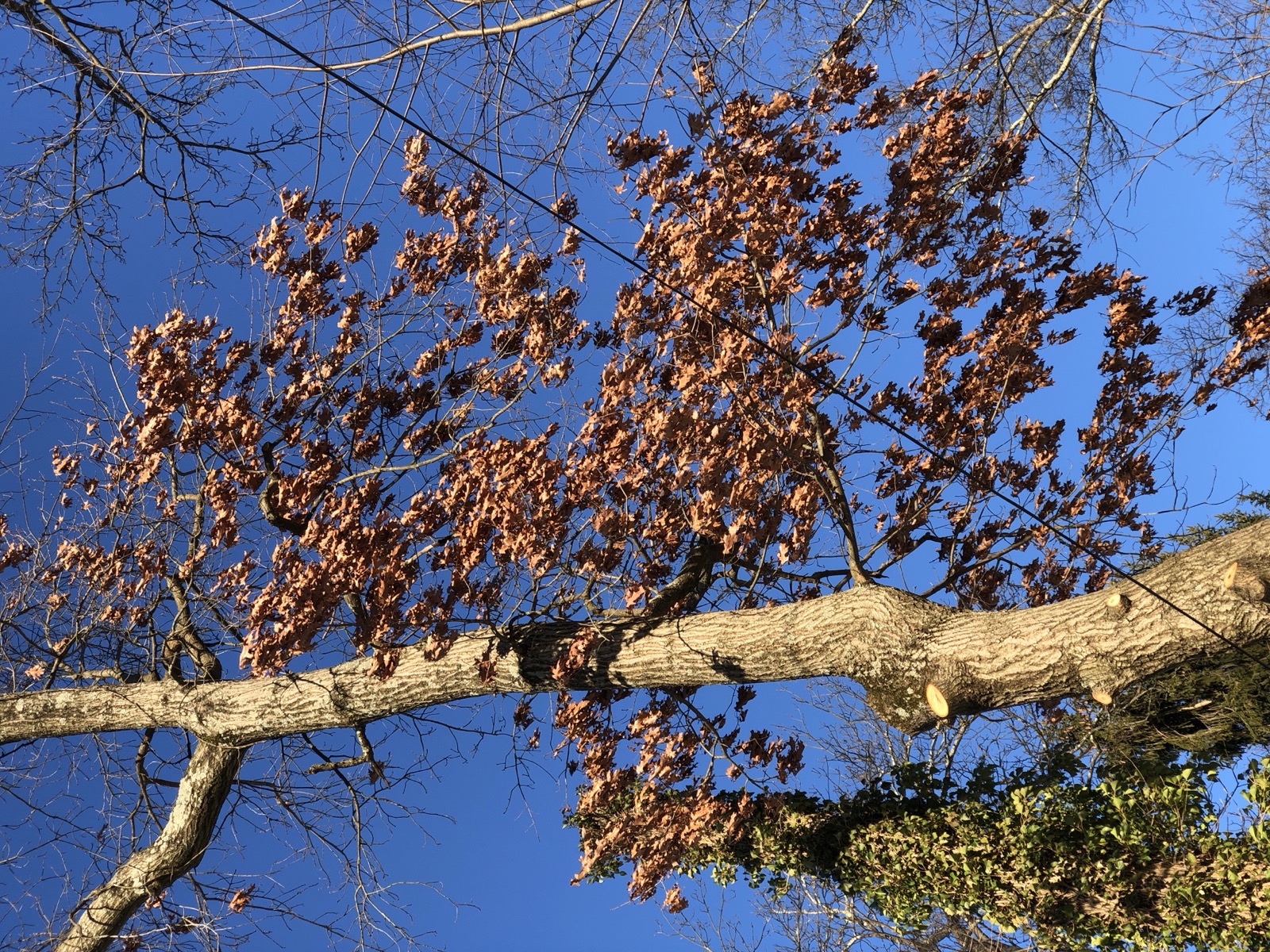
A dead leaf is a dead leaf, whether it falls to the ground in October or hangs limply on its stem until March. That, at least, is the reasonable assumption — and it is wrong.
Across 34 herbaceous plant species grown side by side in a common garden, litter that persisted on the plant as standing-dead tissue — a trait called marcescence — lost a species-level mean of just 38.5% of its mass, compared with 56.6% for litter that had simply been shed and left on the ground. That 18.0-percentage-point gap is not noise: a paired statistical test comparing marcescent against shed litter, species by species, returns p < 0.001 (Wilcoxon signed-rank, z = -4.49), and the pattern holds in 30 of the 34 species studied.
The most extreme case is Jacea pratensis, a forb whose shed litter lost 95.0% of its mass while its marcescent litter lost only 38.5% — essentially the difference between litter that has all but vanished and litter that is still recognizably plant material. This retained-tissue habit, known as marcescence, is a familiar sight in winter woodlands (oaks and beeches holding brown leaves through the cold months), but here it turns out to leave a measurable fingerprint on how fast the plant's remains actually rot.
A Trait Nobody Fully Understands
Marcescence itself is a genuine puzzle in plant biology. It happens when a plant fails to fully form the abscission layer — the specialized zone of cells that normally severs a dead leaf or stem from the rest of the plant — so the dead tissue stays attached instead of falling. Why plants do this at all is unresolved: leading hypotheses include deterring winter browsing by deer (dry, noisy, less palatable tissue), delaying nutrient release until spring when the plant can actually use it, trapping insulating snow, or protecting buds from cold and desiccation. None of these is confirmed as the answer, and it's entirely possible several are true for different species.
This dataset doesn't try to settle that debate. It comes from a common-garden decomposition experiment described in a 2024 Functional Ecology paper (Angst et al.), which sampled marcescent and directly-shed senescent tissue from herbaceous plant species and tracked how much mass each type of litter lost over roughly six months in the organic soil layer. The analysis behind this piece re-derives every statistic directly from the study's own deposited data rather than simply repeating its published numbers.
The core comparison rests on 34 species with both a marcescent and a shed measurement; a separate, larger sample of 58 marcescent-and-shed litter observations with matched microbial-biomass readings supports one further test discussed later. Litter decomposition of this kind is not a narrow academic curiosity — it's one of the processes that determines how fast carbon fixed by photosynthesis either returns to the atmosphere or gets locked into soil, which is why ecologists treat decomposition rate as a meaningful variable in its own right, not just a footnote to plant biology.
Except It's Not Marcescence — It's Forbs
But that headline number hides something. It implies marcescence is a uniform effect — that any plant which retains dead tissue will see its litter decompose more slowly as a result. That's not what the data shows.
The 34 species split into three functional groups: 25 forbs (broad-leaved herbaceous plants), 7 grasses, and 2 legumes — too few to analyze on their own, and excluded from this comparison as the study's plan specified in advance. Comparing forbs against grasses on their per-species marcescent-minus-shed difference gives a Mann-Whitney U = 18.0, p = 0.0007 — a clear, statistically robust split between the two groups.
The magnitude of that split is the real story: forbs show a mean marcescent-minus-shed deficit of -23.1 percentage points, while grasses show just -2.2 percentage points — the forb effect is roughly ten times larger. Put differently, nearly all of the slow-down documented in the previous section is being generated by three-quarters of the species (the forbs); the grasses are, on average, barely affected at all.
Leaves vs. Stems: Two Different Materials
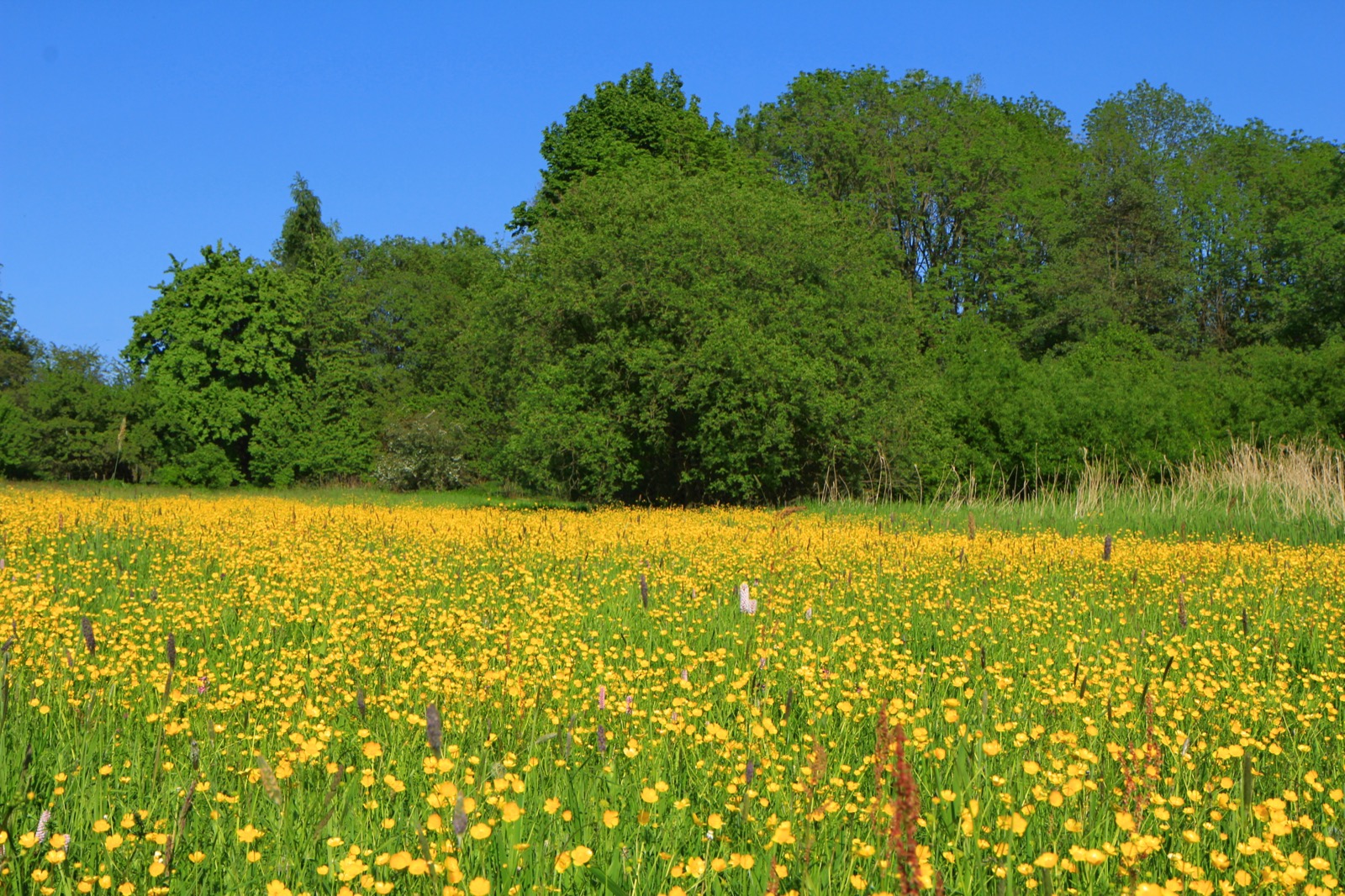
The explanation is architectural, not mysterious. Forbs typically shed their leaves — soft, nutrient-rich tissue that decomposes quickly on its own — while retaining their stems as marcescent litter, and stems are tougher, more heavily lignified material that resists microbial breakdown. Looking at the shed-litter baseline alone makes this concrete: shed forb litter loses a mean 61.2% of its mass, versus only 45.3% for shed grass litter. Forb marcescent tissue, meanwhile, decomposes at only 0.62 times the rate of forb shed tissue — a substantial slow-down. Grass marcescent tissue, by contrast, decomposes at 0.95 times the rate of grass shed tissue — nearly identical.
Grasses don't show this split because their growth form doesn't create it: a grass blade that falls to the ground and a grass blade that stands dead on the plant are, chemically, close to the same material. A forb's fallen leaf and a forb's standing dead stem are not. The functional-group effect, in other words, isn't really about marcescence as an abstract property at all — it's about what kind of tissue a plant happens to be retaining when it doesn't let go.
The Outliers Keep Us Honest
The 34 species don't move in lockstep even within this pattern. Their per-species differences spread from a 56-point slow-down to an 18-point reversal, with half of all species landing somewhere between a 10- and 30-point deficit — a real, forb-driven pattern, but a noisy one at the level of any single species.
Jacea pratensis sits at one extreme: its marcescent litter lost 38.5% of its mass against 95.0% for its shed litter, the single largest gap in the dataset.
Potentilla erecta sits at the other: its marcescent litter (64.9% mass loss) actually decomposed faster than its shed litter (46.4%), a full reversal of the overall pattern. It isn't alone — 4 of the 34 species show this same reversal, two of them forbs and two of them grasses. Reporting these exceptions alongside the headline finding isn't a hedge; it's what keeps "marcescent litter decomposes more slowly" an honest statistical pattern rather than an exceptionless law that the data doesn't actually support.
Checking the Work
The forb-vs-grass split isn't the only test the study ran, and the wider set of results was checked against the possibility that running multiple comparisons manufactures false positives. Four tests were subjected to multiplicity correction — the forb-vs-grass contrast, the within-forb paired test, the within-grass paired test, and the microbial-biomass correlation discussed below — and three of the four remain significant after both Benjamini-Hochberg and Holm correction, the two most common ways of guarding against exactly this kind of statistical inflation.
The one test that doesn't survive is the within-grass comparison itself (p = 0.24): tested on its own, marcescent grass litter doesn't decompose significantly more slowly than shed grass litter. But this should be read carefully — the grass sample (n = 7) is barely a quarter the size of the forb sample (n = 25), so a small real effect could easily fail to reach significance here without being a genuine zero. The honest reading is "not enough grass species to detect a difference," not "grasses definitively show no difference."
A separate line of evidence points at a possible mechanism: microbial biomass on the litter (a measure called Cmic) is positively correlated with how much mass the litter lost (Spearman rho = 0.43, p < 0.001, n = 58) — litter carrying more microbial colonizers tended to have decomposed further. That correlation explains only around 18% of the rank-variance in mass loss on its own, and it's observational, drawn from litter that already differs in chemistry between the marcescent and shed groups — so it's best read as a plausible contributing factor worth testing directly, not proof that microbial colonization causes the slow-down.
What a Retained Leaf Is Really Telling Us
Litter decomposition rates worldwide span roughly a five-fold range, from cold biomes to the tropics, driven mostly by climate and litter chemistry. The roughly 18-point marcescence gap documented here arises from neither — it comes entirely from how a single plant chooses to let go of its own dead tissue, which is a striking amount of leverage for what looks, at a glance, like a cosmetic difference in senescence.
That has real stakes: decomposition rate governs how fast carbon and nutrients cycle back through an ecosystem, so a trait as easy to overlook as "does this plant drop its dead leaves or hold onto them" turns out to help set that pace, at least for the broad-leaved herbs where the effect concentrates.
This is not a closed case. The species here are treated as independent data points even though they span multiple plant families — a simplification the source study itself flags, with a phylogenetically-aware model recommended as a stronger future design. And a companion 2024 study on Himalayan alpine plants asks a related question — why standing dead material matters more in harsh, resource-limited environments — suggesting marcescence research is still actively mapping out where and why this trait matters, rather than having settled on one universal explanation. The next time you notice a stand of dead stems still upright in a winter field, the honest answer to "why does that matter?" is: it depends what kind of plant you're looking at.