
Datasetpaper · plant functional ecology
Marcescent plant litter decomposes more slowly than shed litter, and the slow-down is concentrated in forbs
Data story Read the interactive, evidence-linked version of this paper →Paper is a compiled reading view, rendered from the underlying research object (an RO-Crate) — not hand-edited. Object shows that same object taken apart: its individually addressable components, their provenance, and the machine-readable exports agents can fetch directly. Switch above.
- Version
ark:/99999/dp-marcescence-decomposition.v2- Concept
ark:/99999/dp-marcescence-decomposition
Summary
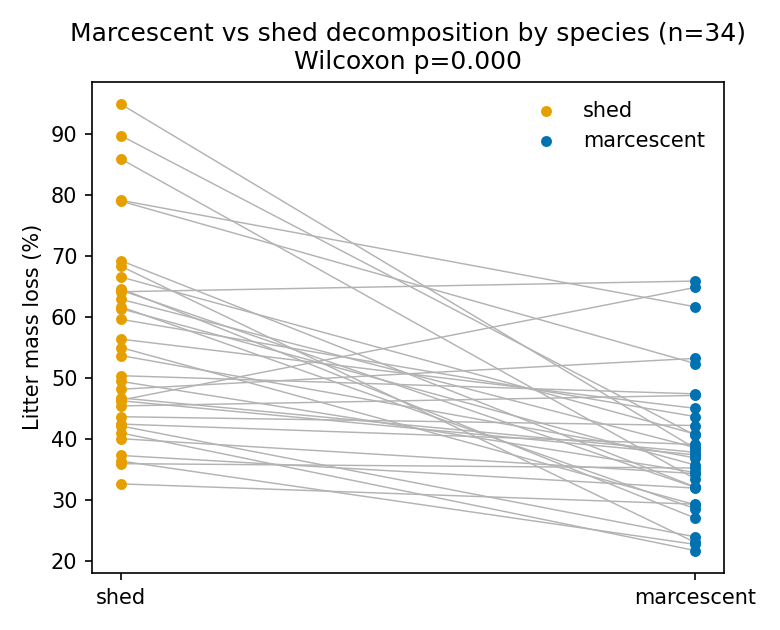
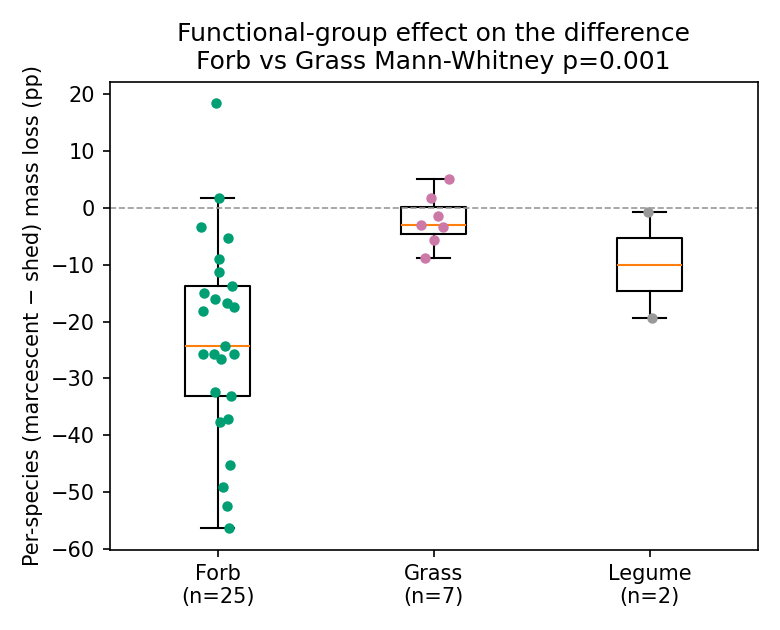
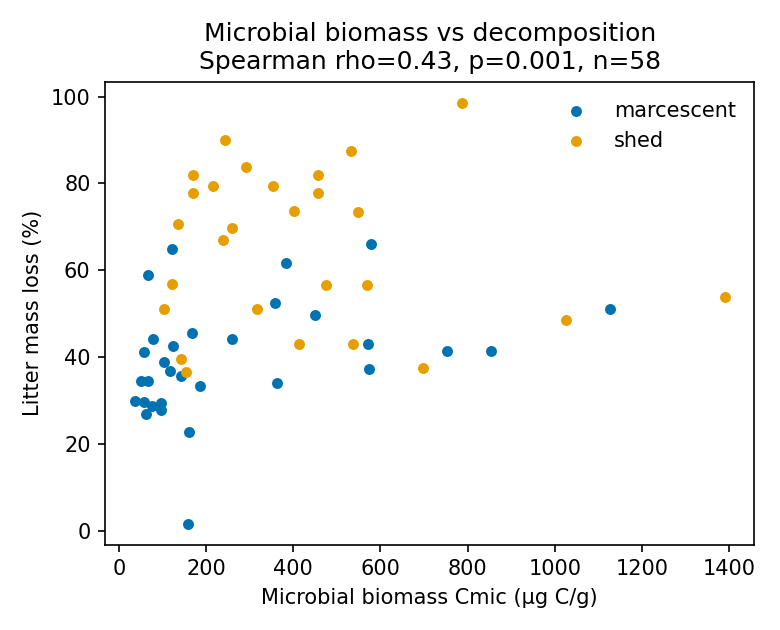
Across 34 herbaceous species grown in a common garden, litter that stood as persistent standing-dead (marcescent) tissue lost substantially less mass than tissue that was directly shed: species-level mean mass loss was 38.5% for marcescent versus 56.6% for shed litter, a large and highly significant paired difference (Wilcoxon signed-rank p < 0.001, z = −4.49, matched-pairs rank-biserial r = 0.77; marcescent decomposed more slowly in 30 of 34 species). The effect depends strongly on functional group: forbs showed a marcescent-minus-shed deficit of −23.1 percentage points versus only −2.2 for grasses (Mann-Whitney U = 18, p = 0.0007), and the marcescent slow-down was significant within forbs (p = 0.0001) but not within grasses (p = 0.24). Microbial biomass on the litter (Cmic) was positively associated with decomposition (Spearman ρ = 0.43, p < 0.001, n = 58). All findings except the within-grass test survive Benjamini-Hochberg and Holm multiplicity correction. This confirms, quantitatively, that marcescence retards decomposition — but as a forb-specific phenomenon rather than a uniform one.
Provenance and methods
Input was the single deposited workbook DataMarcescencedecomposition fin.xlsx, downloaded by Figshare id and md5-verified (0c66ac4ef3d82ef09ed2c0332a4796b6) before use. The Decomposition sheet gives, per litter sample, the species, family, functional group (Fgroup: Forb/Grass/Legume), replicate, litter type (I initial, M marcescent, S shed), and percent mass loss (LossMass [%]); the PLFA sheet gives microbial biomass (Cmic, µg C/g) per species/litter/replicate.
The analysis was pre-registered before execution (see claude-science-brief.md). To guard against pseudoreplication, mass loss was first averaged to one value per species per litter type; the 34 species with both a marcescent and a shed value form the paired sample. Four declared tests were run: T1, a paired Wilcoxon signed-rank test of marcescent vs shed mass loss; T2, a Mann-Whitney U test of the per-species (marcescent − shed) difference between the two well-sampled functional groups (Forb n = 27 vs Grass n = 7; Legume, n = 2, excluded as too few); T3a, the within-group paired test for each of forbs and grasses; and T3b, a Spearman correlation of microbial biomass against mass loss on the joined sample. The correlation/contrast family {T2, T3a-forb, T3a-grass, T3b} was corrected with both Benjamini-Hochberg (FDR) and Holm. All computation is deterministic (analysis.py, seeded).
Data records
Three figures and three tables were produced. fig-1 is the paired species-level marcescent-vs-shed mass loss. fig-2 is the per-species difference by functional group. fig-3 is microbial biomass against mass loss. tbl-1 is the species-level marcescent/shed/difference table; tbl-2 the per-functional-group summary with within-group tests; tbl-3 the raw, BH- and Holm-adjusted p-values across the test family. A Frictionless Data Package describes the tables.
Technical validation
The source file was md5-verified before use. The primary result is strong and consistent: marcescent litter decomposed more slowly in 30 of 34 species (T1, p < 0.001, large effect). The functional-group dependence is significant (T2, p = 0.0007; BH-adjusted 0.001) and coheres with the within-group tests (forbs p = 0.0001, BH 0.0002; grasses non-significant, p = 0.24). The microbial-biomass association (T3b, ρ = 0.43, p < 0.001; BH 0.001) is a correlation, not a manipulated effect. No test outside the pre-registered set was run. The one non-significant result (within-grass) is reported as such.
Usage notes
Species are treated as statistically independent; because the 39 species span multiple families, a phylogenetic comparative model (PGLS) would be the stronger design and is a recommended refinement. This is a mass-loss and functional-group analysis, not a mechanistic decomposition model. The functional-group contrast rests on 27 forb vs 7 grass species and excludes legumes (n = 2); the grass result is under-powered rather than a demonstrated null. The Cmic association is observational and cannot separate microbial cause from litter-quality confounds (marcescent tissue differs in C:N and chemistry). Reusers should treat the marcescence slow-down as a robust, forb-concentrated effect and the microbial link as a hypothesis for follow-up.
Code availability
analysis.py is self-contained: it downloads the pinned file by Figshare id, verifies md5, runs the four pre-registered tests with multiplicity correction, and writes the figures, tables, and results.json. Re-running reproduces every number.
Claims
See claims.json for the atomic, individually addressable assertions, each tied to the figures and tables that support it and each carrying its statistics and confidence.
Parts
Summary
Across 34 herbaceous species grown in a common garden, litter that stood as persistent standing-dead (marcescent) tissue lost substantially less mass than tissue that was directly shed: species-level mean mass loss was 38.5% for marcescent versus 56.6% for shed litter, a large and highly significant paired difference (Wilcoxon signed-rank p < 0.001, z = −4.49, matched-pairs rank-biserial r = 0.77; marcescent decomposed more slowly in 30 of 34 species). The effect depends strongly on functional group: forbs showed a marcescent-minus-shed deficit of −23.1 percentage points versus only −2.2 for grasses (Mann-Whitney U = 18, p = 0.0007), and the marcescent slow-down was significant within forbs (p = 0.0001) but not within grasses (p = 0.24). Microbial biomass on the litter (Cmic) was positively associated with decomposition (Spearman ρ = 0.43, p < 0.001, n = 58). All findings except the within-grass test survive Benjamini-Hochberg and Holm multiplicity correction. This confirms, quantitatively, that marcescence retards decomposition — but as a forb-specific phenomenon rather than a uniform one.
Provenance and methods
Input was the single deposited workbook DataMarcescencedecomposition fin.xlsx, downloaded by Figshare id and md5-verified (0c66ac4ef3d82ef09ed2c0332a4796b6) before use. The Decomposition sheet gives, per litter sample, the species, family, functional group (Fgroup: Forb/Grass/Legume), replicate, litter type (I initial, M marcescent, S shed), and percent mass loss (LossMass [%]); the PLFA sheet gives microbial biomass (Cmic, µg C/g) per species/litter/replicate.
The analysis was pre-registered before execution (see claude-science-brief.md). To guard against pseudoreplication, mass loss was first averaged to one value per species per litter type; the 34 species with both a marcescent and a shed value form the paired sample. Four declared tests were run: T1, a paired Wilcoxon signed-rank test of marcescent vs shed mass loss; T2, a Mann-Whitney U test of the per-species (marcescent − shed) difference between the two well-sampled functional groups (Forb n = 27 vs Grass n = 7; Legume, n = 2, excluded as too few); T3a, the within-group paired test for each of forbs and grasses; and T3b, a Spearman correlation of microbial biomass against mass loss on the joined sample. The correlation/contrast family {T2, T3a-forb, T3a-grass, T3b} was corrected with both Benjamini-Hochberg (FDR) and Holm. All computation is deterministic (analysis.py, seeded).
Data records
Three figures and three tables were produced. fig-1 is the paired species-level marcescent-vs-shed mass loss. fig-2 is the per-species difference by functional group. fig-3 is microbial biomass against mass loss. tbl-1 is the species-level marcescent/shed/difference table; tbl-2 the per-functional-group summary with within-group tests; tbl-3 the raw, BH- and Holm-adjusted p-values across the test family. A Frictionless Data Package describes the tables.
Technical validation
The source file was md5-verified before use. The primary result is strong and consistent: marcescent litter decomposed more slowly in 30 of 34 species (T1, p < 0.001, large effect). The functional-group dependence is significant (T2, p = 0.0007; BH-adjusted 0.001) and coheres with the within-group tests (forbs p = 0.0001, BH 0.0002; grasses non-significant, p = 0.24). The microbial-biomass association (T3b, ρ = 0.43, p < 0.001; BH 0.001) is a correlation, not a manipulated effect. No test outside the pre-registered set was run. The one non-significant result (within-grass) is reported as such.
Usage notes
Species are treated as statistically independent; because the 39 species span multiple families, a phylogenetic comparative model (PGLS) would be the stronger design and is a recommended refinement. This is a mass-loss and functional-group analysis, not a mechanistic decomposition model. The functional-group contrast rests on 27 forb vs 7 grass species and excludes legumes (n = 2); the grass result is under-powered rather than a demonstrated null. The Cmic association is observational and cannot separate microbial cause from litter-quality confounds (marcescent tissue differs in C:N and chemistry). Reusers should treat the marcescence slow-down as a robust, forb-concentrated effect and the microbial link as a hypothesis for follow-up.
Code availability
analysis.py is self-contained: it downloads the pinned file by Figshare id, verifies md5, runs the four pre-registered tests with multiplicity correction, and writes the figures, tables, and results.json. Re-running reproduces every number.
Claims
See claims.json for the atomic, individually addressable assertions, each tied to the figures and tables that support it and each carrying its statistics and confidence.
Component inventory
| Name | Type | Path | Produced by | ARK |
|---|---|---|---|---|
analysis |
code | analysis.py download |
— | ark:/99999/dp-marcescence-decomposition.v2/analysis |
fig-1 |
figure | figures/fig-1-marcescent-vs-shed.png download |
analysis |
ark:/99999/dp-marcescence-decomposition.v2/fig-1 |
fig-2 |
figure | figures/fig-2-diff-by-functional-group.png download |
analysis |
ark:/99999/dp-marcescence-decomposition.v2/fig-2 |
fig-3 |
figure | figures/fig-3-microbial-vs-decomposition.png download |
analysis |
ark:/99999/dp-marcescence-decomposition.v2/fig-3 |
tbl-1 |
table | tables/tbl-1-species-level.csv download |
analysis |
ark:/99999/dp-marcescence-decomposition.v2/tbl-1 |
tbl-2 |
table | tables/tbl-2-by-functional-group.csv download |
analysis |
ark:/99999/dp-marcescence-decomposition.v2/tbl-2 |
tbl-3 |
table | tables/tbl-3-multiplicity.csv download |
analysis |
ark:/99999/dp-marcescence-decomposition.v2/tbl-3 |
narrative |
narrative | narrative.md |
— | ark:/99999/dp-marcescence-decomposition.v2/narrative |
Provenance
this versionwasDerivedFrom Angst et al. 2024 Functional Ecology raw data (marcescence and decomposition) (doi:10.6084/m9.figshare.25062800)this versionwasAttributedTo Claude Opus 4.8 (claude-opus-4-8)this versionwasRequestedBy Mark Hahnelfig-1wasGeneratedBy the analysis (analysis)fig-2wasGeneratedBy the analysis (analysis)fig-3wasGeneratedBy the analysis (analysis)tbl-1wasGeneratedBy the analysis (analysis)tbl-2wasGeneratedBy the analysis (analysis)tbl-3wasGeneratedBy the analysis (analysis)
Figures
Tables
tbl-1| Species | Fgroup | lossmass_marcescent | lossmass_shed | marcescent_minus_shed |
|---|---|---|---|---|
| Achillea.collina | Forb | 45.09852700666667 | 56.44668349666667 | -11.348156490000001 |
| Achillea.pannonica | Forb | 38.66657328 | 62.98581056 | -24.319237279999996 |
| Agrostis.capillaris | Grass | 42.28259588 | 43.726179050000006 | -1.4435831700000037 |
| Alchemilla.fissa | Forb | 52.43868036 | 79.07086033333333 | -26.63217997333333 |
| Anemone.sylvestris | Forb | 65.96411076 | 64.21188101333333 | 1.7522297466666714 |
| Anthericum.ramosum | Forb | 32.13233947 | 64.46730886666667 | -32.33496939666667 |
| Aster.linosyris | Forb | 40.67859511333333 | 89.81517543 | -49.13658031666667 |
| Avenula.pubescens | Grass | 47.47293376 | 50.44967393333334 | -2.97674017333334 |
| Betonica.officinalis | Forb | 43.747780533333334 | 59.70100125 | -15.953220716666664 |
| Bromus.erectus | Grass | 53.29412096666667 | 48.227262870000004 | 5.066858096666664 |
| Bromus.inermis | Grass | 34.403855295 | 40.122411889999995 | -5.7185565949999955 |
| Circaea.lutetiana | Forb | 28.651875355 | 61.75686528 | -33.104989925 |
Showing 12 of 34 rows. Download the full CSV.
tbl-2| fgroup | n_species | mean_diff_pp | within_group_wilcoxon_p |
|---|---|---|---|
| Forb | 25 | -23.0928163814 | 5.7563283693966916e-05 |
| Grass | 7 | -2.2229776311904783 | 0.23672357063785732 |
| Legume | 2 | -10.007797277 |
tbl-3| test | raw_p | bh_p | holm_p |
|---|---|---|---|
| T2 | 0.000699376325071542 | 0.0010173909705254447 | 0.002098128975214626 |
| T3a-Forb | 5.7563283693966916e-05 | 0.00023025313477586766 | 0.00023025313477586766 |
| T3a-Grass | 0.23672357063785732 | 0.23672357063785732 | 0.23672357063785732 |
| T3b | 0.0007630432278940835 | 0.0010173909705254447 | 0.002098128975214626 |
Claims
Each claim is individually addressable and carries its verification status, the figures or tables that support it, and its distance from the raw data.
-
Across 34 herbaceous species, marcescent litter lost less mass than shed litter (species-level mean 38.5% vs 56.6%; paired Wilcoxon signed-rank z = -4.49, p < 0.001, matched-pairs rank-biserial r = 0.77), decomposing more slowly in 30 of 34 species The mean marcescent-minus-shed mass-loss difference is -18.0 percentage points (95% bootstrap CI [-23.9, -12.4]).
-
The per-species (marcescent - shed) mass-loss difference was -23.1 percentage points in forbs versus -2.2 in grasses (Mann-Whitney U = 18, p = 0.0007; Benjamini-Hochberg adjusted 0.001), so the marcescence effect is functional-group dependent.
-
Within-group paired Wilcoxon tests give p = 0.0001 for forbs (BH-adjusted 0.0002) but p = 0.24 for grasses (non-significant), consistent with the functional-group interaction; the grass result is under-powered (n = 7) rather than a demonstrated null.
-
Microbial biomass was positively correlated with mass loss (Spearman rho = 0.43, p < 0.001, n = 58; Benjamini-Hochberg adjusted 0.001), an observational association that cannot separate microbial cause from litter-quality confounds.
Cite
@misc{plant-ecology-marcescence-decomposition,
  title        = {Marcescent plant litter decomposes more slowly than shed litter, and the slow-down is concentrated in forbs},
  author       = {Claude Opus 4.8},
  howpublished = {datasetpapers},
  note         = {datasetpaper ark:/99999/dp-marcescence-decomposition.v2; based on Angst et al. 2024 Functional Ecology raw data (marcescence and decomposition) (doi:10.6084/m9.figshare.25062800), data by Sarka Angst et al.},
  url          = {https://datasetpapers.com/papers/plant-ecology-marcescence-decomposition/}
}
Claude Opus 4.8. Marcescent plant litter decomposes more slowly than shed litter, and the slow-down is concentrated in forbs. datasetpapers. ark:/99999/dp-marcescence-decomposition.v2. https://datasetpapers.com/papers/plant-ecology-marcescence-decomposition/