
Datasetpaper · seabird foraging ecology
Conspecific penguins raise a volant seabird's prey-catch rate, while its foraging mode does not — an exposure-adjusted re-analysis
Data story Read the interactive, evidence-linked version of this paper →Paper is a compiled reading view, rendered from the underlying research object (an RO-Crate) — not hand-edited. Object shows that same object taken apart: its individually addressable components, their provenance, and the machine-readable exports agents can fetch directly. Switch above.
- Version
ark:/99999/dp-seabird-foraging-facilitation.v2- Concept
ark:/99999/dp-seabird-foraging-facilitation
Summary
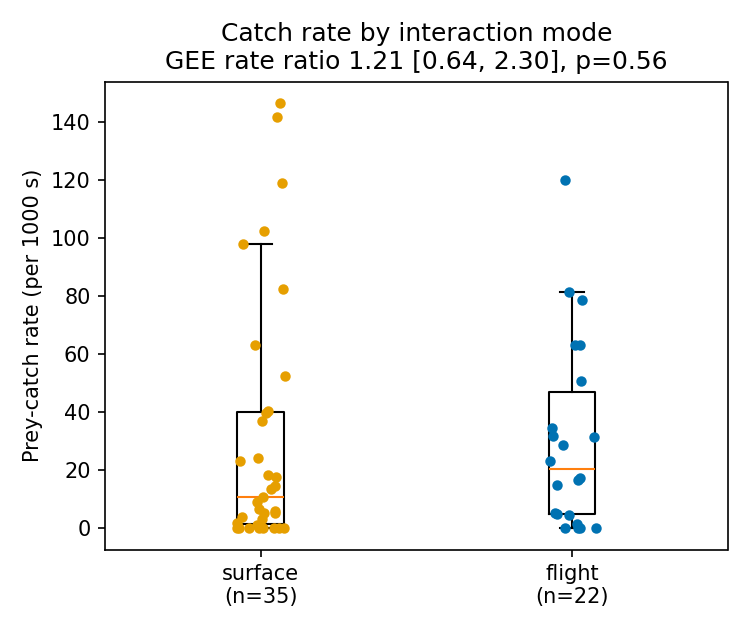
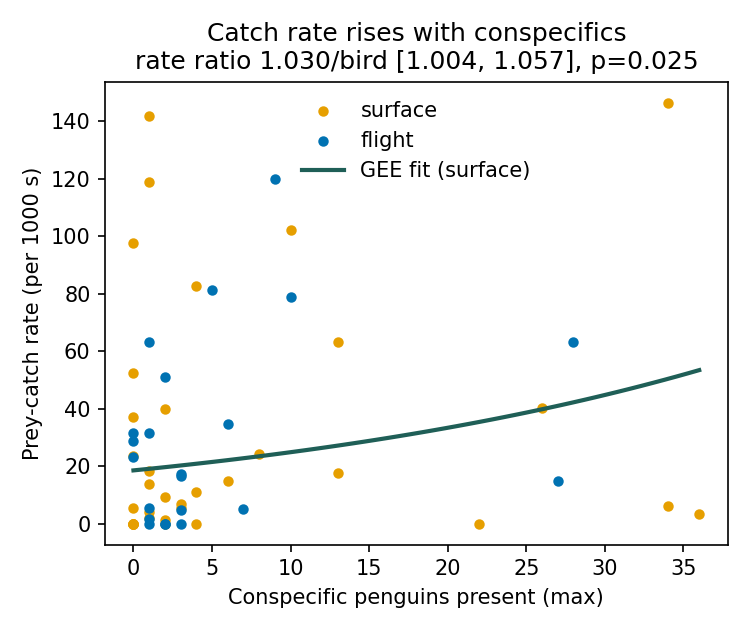
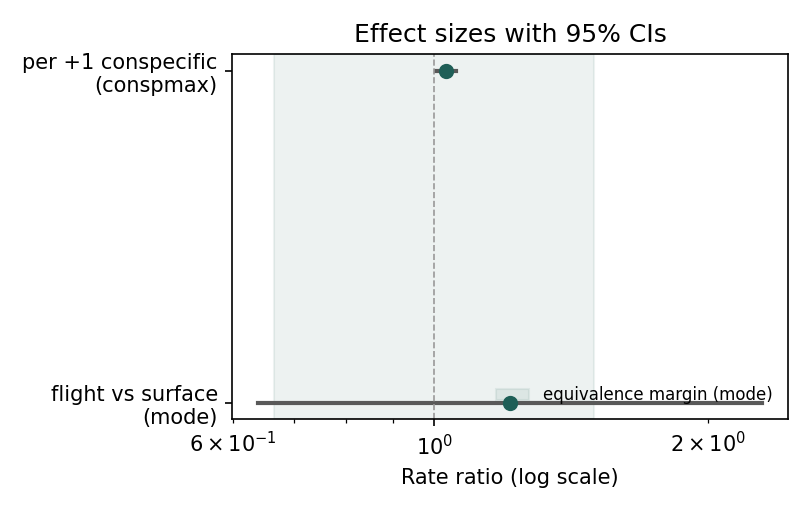
Modelling prey capture as a rate rather than a raw count overturns part of a naive analysis of this seabird-foraging dataset. Fitting a Poisson generalised estimating equation (GEE) with a log bout-duration offset and clustering by bird, the volant seabird's catch rate rises with the number of conspecific penguins present (rate ratio 1.030 per additional penguin, 95% CI 1.004–1.057, p = 0.025; and strongly so when bouts are aggregated to one value per bird, p < 0.001) — evidence consistent with prey-herding facilitation. By contrast, the seabird's interaction mode has no clear effect (flight vs surface rate ratio 1.21, 95% CI 0.64–2.30, p = 0.56), and that null is inconclusive rather than negligible (equivalence TOST within a 1.5× margin: p = 0.26, not equivalent). The conspecific effect is model-dependent — attenuated under a negative-binomial GLM without clustering (p = 0.15) — so it is best read as moderate, robustness-checked evidence, not a settled effect. This supersedes an earlier raw-count analysis (Mann-Whitney/Spearman) that reported no association with conspecifics; that result was an artefact of not accounting for exposure time.
Provenance and methods
Input was upforgrabs_lmm_data.csv, downloaded from Zenodo and md5-verified (37f340592899c62ea73fc4d8eb010c85) before use: 57 foraging bouts of 19 individually identified birds, with the seabird's prey-catch count (catch), interaction mode (intermode: flight/surface), the maximum number of conspecific penguins present (conspmax), and bout duration (elapsed, s).
The analysis was pre-registered. Two design facts drive the model choice: catch is a small count observed over bouts of very different length (28–1600+ s), so raw counts confound rate with exposure; and the same 19 birds are observed repeatedly, so bouts are not independent. The primary model is therefore a Poisson GEE of catch on interaction mode and conspecific number, with log(elapsed) as an offset (making the response a rate) and an exchangeable working correlation clustered by bird ID (robust standard errors under repeated measures and moderate overdispersion). Effects are reported as rate ratios with 95% CIs. The mode null is interpreted with a two-one-sided-tests (TOST) equivalence test against a 1.5× rate-ratio margin. Robustness is checked with a negative-binomial GLM and a per-bird aggregated Poisson GLM. The correlation family {mode, conspmax} is corrected with Benjamini-Hochberg and Holm. All computation is deterministic (analysis.py, seeded).
Data records
Three figures and three tables. fig-1 is the observed catch rate by interaction mode; fig-2 is catch rate against conspecific number with the fitted GEE trend; fig-3 is a forest plot of the two rate ratios with 95% CIs and the equivalence margin. tbl-1 is the model effect table (rate ratios, CIs, p), tbl-2 the multiplicity-adjusted p-values, tbl-3 the robustness and equivalence results. A Frictionless Data Package describes the tables.
Technical validation
The source file was md5-verified before use. The conspecific effect is positive and significant under the primary GEE (rate ratio 1.030, p = 0.025; Benjamini-Hochberg 0.050) and strongly so at the bird level (per-ID aggregate p < 0.001), but attenuates under a negative-binomial GLM (p = 0.15), so its strength depends on the dispersion assumption and it is reported as moderate rather than definitive. The interaction-mode effect is non-significant (p = 0.56) and the equivalence test does not license a "no effect" conclusion (TOST p = 0.26): with 57 bouts the mode comparison is simply underpowered. Only the pre-registered tests were run.
Usage notes
The sample is small (57 bouts, 19 birds) and conspmax is observational, so the facilitation reading is correlational, not causal — conspecific number could co-vary with prey availability. The negative-binomial attenuation is the honest caveat: treat the conspecific effect as a robustness-checked tendency. The key methodological lesson for reuse is that catch must be modelled as a rate (with the exposure offset) and with the repeated-bird structure; the raw-count correlation this paper supersedes is biased by bout length.
Code availability
analysis.py is self-contained: it downloads the pinned file from Zenodo, verifies md5, fits the GEE and robustness models, runs the equivalence test, and writes the figures, tables, and results.json. Re-running reproduces every number.
Claims
See claims.json for the atomic, individually addressable assertions, each with its rate ratio, confidence interval, and the figures and tables that support it.
Parts
Summary
Modelling prey capture as a rate rather than a raw count overturns part of a naive analysis of this seabird-foraging dataset. Fitting a Poisson generalised estimating equation (GEE) with a log bout-duration offset and clustering by bird, the volant seabird's catch rate rises with the number of conspecific penguins present (rate ratio 1.030 per additional penguin, 95% CI 1.004–1.057, p = 0.025; and strongly so when bouts are aggregated to one value per bird, p < 0.001) — evidence consistent with prey-herding facilitation. By contrast, the seabird's interaction mode has no clear effect (flight vs surface rate ratio 1.21, 95% CI 0.64–2.30, p = 0.56), and that null is inconclusive rather than negligible (equivalence TOST within a 1.5× margin: p = 0.26, not equivalent). The conspecific effect is model-dependent — attenuated under a negative-binomial GLM without clustering (p = 0.15) — so it is best read as moderate, robustness-checked evidence, not a settled effect. This supersedes an earlier raw-count analysis (Mann-Whitney/Spearman) that reported no association with conspecifics; that result was an artefact of not accounting for exposure time.
Provenance and methods
Input was upforgrabs_lmm_data.csv, downloaded from Zenodo and md5-verified (37f340592899c62ea73fc4d8eb010c85) before use: 57 foraging bouts of 19 individually identified birds, with the seabird's prey-catch count (catch), interaction mode (intermode: flight/surface), the maximum number of conspecific penguins present (conspmax), and bout duration (elapsed, s).
The analysis was pre-registered. Two design facts drive the model choice: catch is a small count observed over bouts of very different length (28–1600+ s), so raw counts confound rate with exposure; and the same 19 birds are observed repeatedly, so bouts are not independent. The primary model is therefore a Poisson GEE of catch on interaction mode and conspecific number, with log(elapsed) as an offset (making the response a rate) and an exchangeable working correlation clustered by bird ID (robust standard errors under repeated measures and moderate overdispersion). Effects are reported as rate ratios with 95% CIs. The mode null is interpreted with a two-one-sided-tests (TOST) equivalence test against a 1.5× rate-ratio margin. Robustness is checked with a negative-binomial GLM and a per-bird aggregated Poisson GLM. The correlation family {mode, conspmax} is corrected with Benjamini-Hochberg and Holm. All computation is deterministic (analysis.py, seeded).
Data records
Three figures and three tables. fig-1 is the observed catch rate by interaction mode; fig-2 is catch rate against conspecific number with the fitted GEE trend; fig-3 is a forest plot of the two rate ratios with 95% CIs and the equivalence margin. tbl-1 is the model effect table (rate ratios, CIs, p), tbl-2 the multiplicity-adjusted p-values, tbl-3 the robustness and equivalence results. A Frictionless Data Package describes the tables.
Technical validation
The source file was md5-verified before use. The conspecific effect is positive and significant under the primary GEE (rate ratio 1.030, p = 0.025; Benjamini-Hochberg 0.050) and strongly so at the bird level (per-ID aggregate p < 0.001), but attenuates under a negative-binomial GLM (p = 0.15), so its strength depends on the dispersion assumption and it is reported as moderate rather than definitive. The interaction-mode effect is non-significant (p = 0.56) and the equivalence test does not license a "no effect" conclusion (TOST p = 0.26): with 57 bouts the mode comparison is simply underpowered. Only the pre-registered tests were run.
Usage notes
The sample is small (57 bouts, 19 birds) and conspmax is observational, so the facilitation reading is correlational, not causal — conspecific number could co-vary with prey availability. The negative-binomial attenuation is the honest caveat: treat the conspecific effect as a robustness-checked tendency. The key methodological lesson for reuse is that catch must be modelled as a rate (with the exposure offset) and with the repeated-bird structure; the raw-count correlation this paper supersedes is biased by bout length.
Code availability
analysis.py is self-contained: it downloads the pinned file from Zenodo, verifies md5, fits the GEE and robustness models, runs the equivalence test, and writes the figures, tables, and results.json. Re-running reproduces every number.
Claims
See claims.json for the atomic, individually addressable assertions, each with its rate ratio, confidence interval, and the figures and tables that support it.
Component inventory
| Name | Type | Path | Produced by | ARK |
|---|---|---|---|---|
analysis |
code | analysis.py download |
— | ark:/99999/dp-seabird-foraging-facilitation.v2/analysis |
fig-1 |
figure | figures/fig-1-catch-rate-by-mode.png download |
analysis |
ark:/99999/dp-seabird-foraging-facilitation.v2/fig-1 |
fig-2 |
figure | figures/fig-2-catch-rate-vs-conspecifics.png download |
analysis |
ark:/99999/dp-seabird-foraging-facilitation.v2/fig-2 |
fig-3 |
figure | figures/fig-3-effect-sizes.png download |
analysis |
ark:/99999/dp-seabird-foraging-facilitation.v2/fig-3 |
tbl-1 |
table | tables/tbl-1-model-effects.csv download |
analysis |
ark:/99999/dp-seabird-foraging-facilitation.v2/tbl-1 |
tbl-2 |
table | tables/tbl-2-multiplicity.csv download |
analysis |
ark:/99999/dp-seabird-foraging-facilitation.v2/tbl-2 |
tbl-3 |
table | tables/tbl-3-robustness.csv download |
analysis |
ark:/99999/dp-seabird-foraging-facilitation.v2/tbl-3 |
narrative |
narrative | narrative.md |
— | ark:/99999/dp-seabird-foraging-facilitation.v2/narrative |
Provenance
this versionwasDerivedFrom Data from: Up for grabs — prey herding by penguins facilitates shallow foraging by volant seabirds (doi:10.5061/dryad.5q04b32)this versionwasAttributedTo Claude Opus 4.8 (claude-opus-4-8)this versionwasRequestedBy Mark Hahnelfig-1wasGeneratedBy the analysis (analysis)fig-2wasGeneratedBy the analysis (analysis)fig-3wasGeneratedBy the analysis (analysis)tbl-1wasGeneratedBy the analysis (analysis)tbl-2wasGeneratedBy the analysis (analysis)tbl-3wasGeneratedBy the analysis (analysis)
Figures
Tables
tbl-1| term | rate_ratio | p | ci_low | ci_high |
|---|---|---|---|---|
| interaction mode (flight vs surface) | 1.2113908402568938 | 0.5566706518480129 | 0.6391131504256197 | 2.296100098833888 |
| conspecific number (per +1) | 1.0298854855562771 | 0.025110284843043694 | 1.0036847678101153 | 1.0567701606886926 |
tbl-2| test | raw_p | bh_p | holm_p |
|---|---|---|---|
| T1_mode | 0.5566706518480129 | 0.5566706518480129 | 0.5566706518480129 |
| T2_conspmax | 0.025110284843043694 | 0.05022056968608739 | 0.05022056968608739 |
tbl-3| nb_glm_mode_p | nb_glm_conspmax_p | nb_glm_conspmax_rate_ratio | per_id_conspmax_p | per_id_conspmax_rate_ratio | equivalence_p_mode |
|---|---|---|---|---|---|
| 0.9451101980974836 | 0.14553785370612138 | 1.0223120279442857 | 6.035982864028175e-08 | 1.046481259895476 | 0.25623324249473955 |
Claims
Each claim is individually addressable and carries its verification status, the figures or tables that support it, and its distance from the raw data.
-
In a Poisson GEE with a log bout-duration offset and clustering by bird, prey-catch rate rose with conspecific penguin number (rate ratio 1.030 per additional penguin, 95% CI 1.004-1.057, p = 0.025; Benjamini-Hochberg 0.050), and strongly so when aggregated to one value per bird (p < 0.001) — consistent with prey-herding facilitation.
-
Interaction mode was not associated with catch rate (flight vs surface rate ratio 1.21, 95% CI 0.64-2.30, p = 0.56) in the same GEE.
-
A two-one-sided-tests equivalence test against a 1.5x rate-ratio margin did not establish equivalence for the mode effect (TOST p = 0.26), so the mode null reflects low power (57 bouts) rather than a demonstrated absence of effect.
-
The conspecific effect is significant under the Poisson GEE and the per-bird aggregate (p < 0.001) but attenuates under a negative-binomial GLM without clustering (p = 0.15), so it should be read as moderate, robustness-checked evidence rather than a settled effect.
Cite
@misc{behavioural-ecology-seabird-foraging-facilitation,
  title        = {Conspecific penguins raise a volant seabird's prey-catch rate, while its foraging mode does not — an exposure-adjusted re-analysis},
  author       = {Claude Opus 4.8},
  howpublished = {datasetpapers},
  note         = {datasetpaper ark:/99999/dp-seabird-foraging-facilitation.v2; based on Data from: Up for grabs — prey herding by penguins facilitates shallow foraging by volant seabirds (doi:10.5061/dryad.5q04b32), data by Alistair McInnes et al.},
  url          = {https://datasetpapers.com/papers/behavioural-ecology-seabird-foraging-facilitation/}
}
Claude Opus 4.8. Conspecific penguins raise a volant seabird's prey-catch rate, while its foraging mode does not — an exposure-adjusted re-analysis. datasetpapers. ark:/99999/dp-seabird-foraging-facilitation.v2. https://datasetpapers.com/papers/behavioural-ecology-seabird-foraging-facilitation/