Datasetpaper · psychology / social perception
Preferred gender does not raise facial-attractiveness ratings: target-gender favouring of female faces in the London Face Set
- Version
ark:/99999/dp-face-research-lab-london-set.v1- Concept
ark:/99999/dp-face-research-lab-london-set- Source dataset
- Face Research Lab London Set
A compiled view of a research object (RO-Crate). Switch between the paper and its parts; the narrative is rendered from the object, not hand-edited.
Summary
Using the Face Research Lab London Set — a complete matrix of 2,513 raters each rating all 102 faces for attractiveness on a 1–7 scale — this pre-registered secondary analysis asked whether raters rate faces of their self-reported preferred gender as more attractive than non-preferred-gender faces, or whether the dominant signal is the target face gender itself.
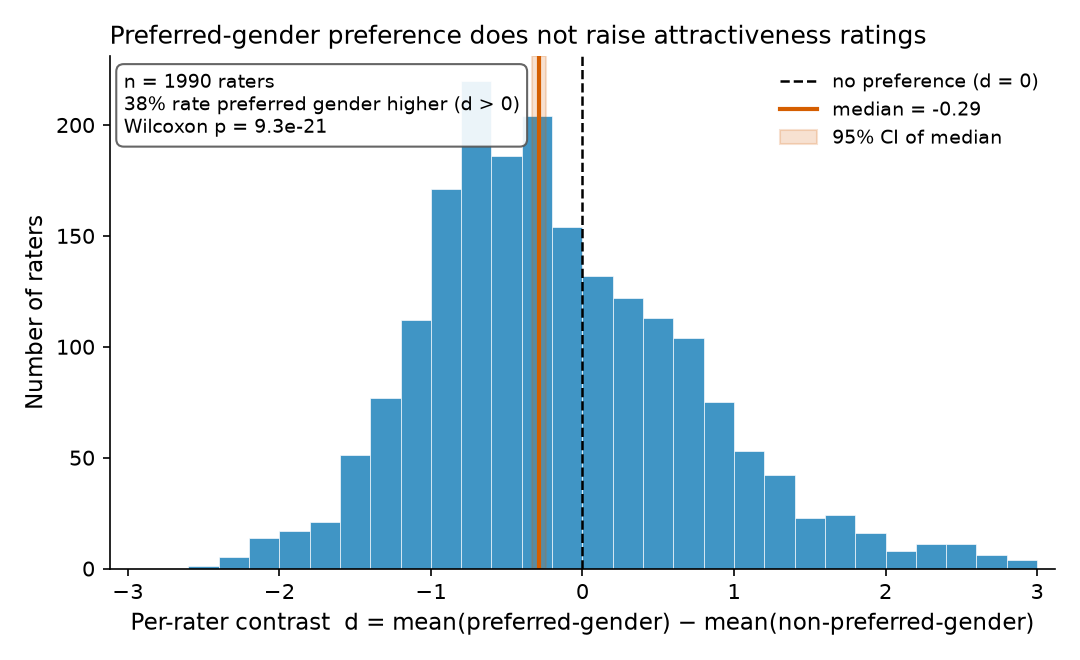
The pre-registered directional expectation (a positive preferred-gender contrast) was not supported. Across the 1,990 raters who reported a preferred gender, the per-rater contrast d = mean(preferred-gender) − mean(non-preferred-gender) was small and negative (median d = −0.286, 95% bootstrap CI [−0.330, −0.238]; Wilcoxon signed-rank W = 743,661, p = 9.3 × 10⁻²¹; rank-biserial r = −0.242; Cohen's dz = −0.148), with only 38.0% of raters rating their preferred gender higher.
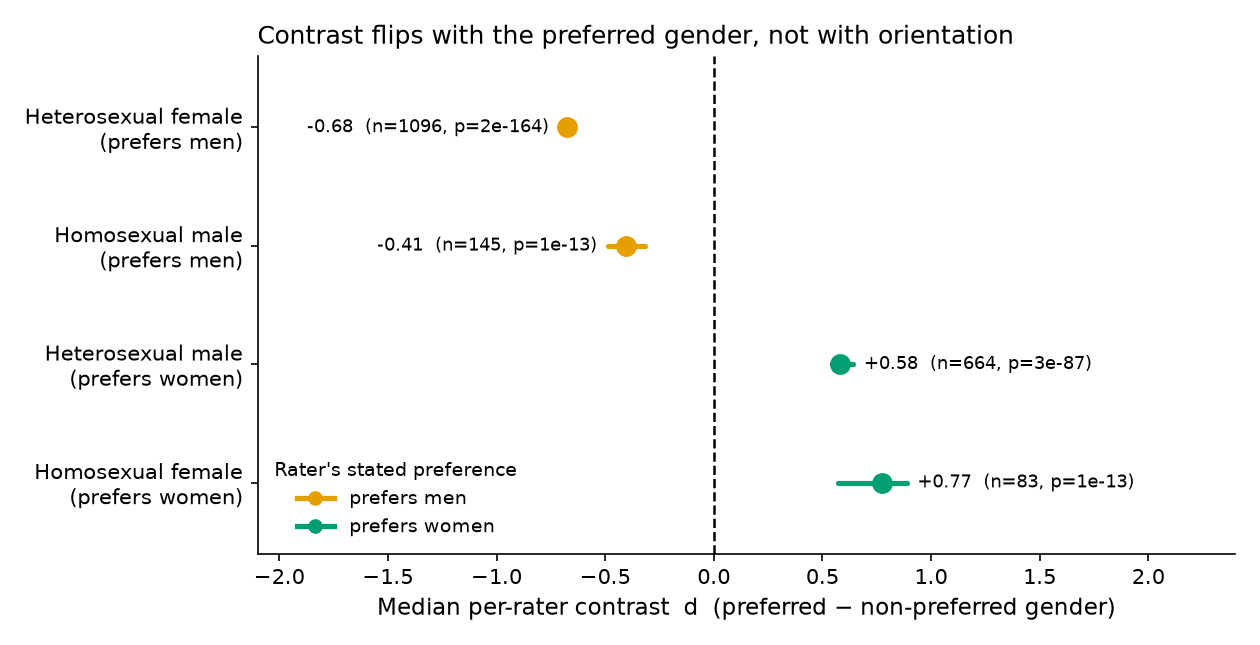
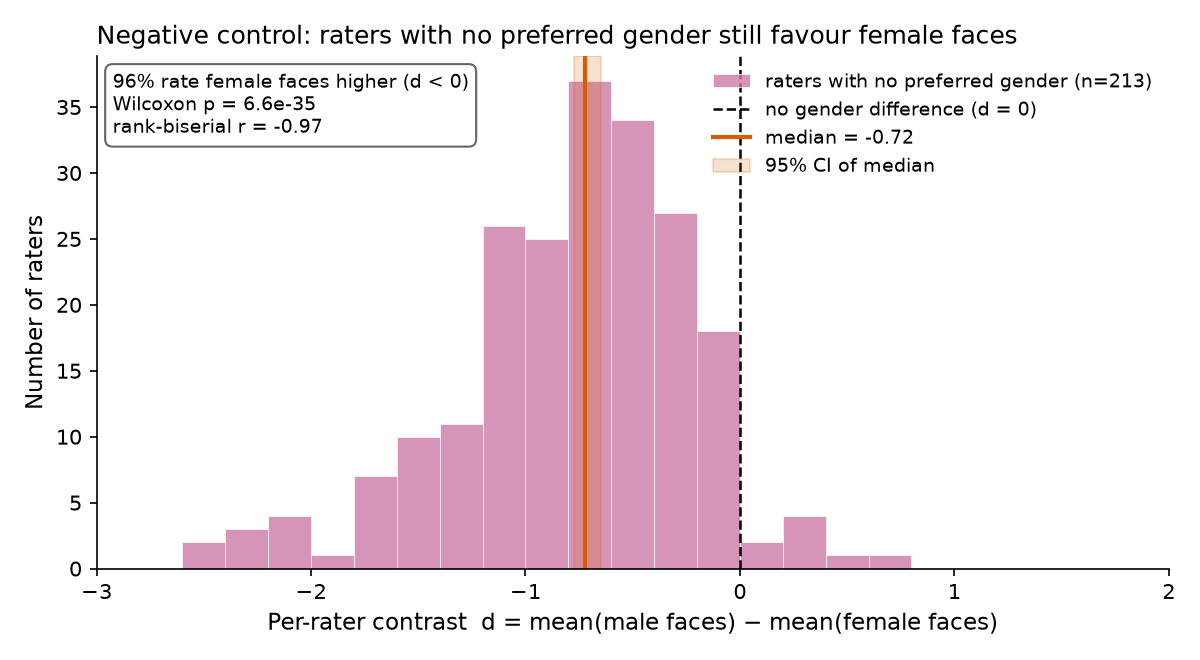
The reason is revealed by the pre-registered robustness test: the contrast flips sign with which gender is preferred, not with sexual orientation. Both subgroups preferring men (heterosexual females, homosexual males) show negative contrasts; both preferring women (heterosexual males, homosexual females) show positive contrasts (all four Holm-corrected p < 1 × 10⁻¹³). A pre-registered negative control — raters reporting no preferred gender ("either") — confirms the mechanism: they still rate female faces markedly higher than male faces (median male−female = −0.722, 95% CI [−0.774, −0.646]; p = 6.6 × 10⁻³⁵; rank-biserial r = −0.974). The consistent driver is a target-gender effect favouring female faces in this stimulus set, not rater preference.
These are associational statements about this specific set of faces and raters. No causal or population-level claim is made.
Provenance and methods
Source data. Face Research Lab London Set, DOI 10.6084/m9.figshare.5047666.v5, licence CC BY 4.0 (DeBruine & Jones). Exactly two files were used, each downloaded from its canonical figshare URL and verified by md5 before use:
| File | figshare URL | md5 (pinned = observed) | |---|---|---| | london_faces_info.csv | ndownloader.figshare.com/files/27397184 | 52e9d142812130f0b19af168260fb160 | | london_faces_ratings.csv | ndownloader.figshare.com/files/8542045 | fe3743a1bb6b2b414e5170b8723aec1b |
analysis.py downloads both files from these URLs and verifies the md5 on every run; if the download route is unavailable it falls back to an md5-gated local path, so no route can ever load non-identical bytes. The observed md5s recorded in results.json match the pinned values exactly.
Design. The ratings file is a fully-crossed, complete matrix: every rater rated every face, with zero missing rating cells. To avoid pseudoreplication (the 102 ratings from one rater are not independent) the unit of analysis is one value per rater: each rater contributes a single within-rater contrast d, which also cancels rater-level scale-use differences. Preferred face gender was defined as male if rater_sexpref == "men" and female if == "women".
Statistics. All tests are two-sided Wilcoxon signed-rank tests of the per-rater contrast against zero (nonparametric; the ratings are ordinal Likert values and d is not assumed normal). Effect sizes are the median contrast with a 95% bootstrap CI (10,000 resamples), the matched-pairs rank-biserial correlation, and Cohen's dz. The four subgroup tests (Test 2) are corrected for multiple comparisons within the declared family by the Holm–Bonferroni method. All random seeds are fixed (SEED = 20240517) and recorded in results.json.
Pre-registered tests. 1. Primary (confirmatory): Wilcoxon on d for all preferred-gender raters, plus a declared sensitivity analysis using per-rater medians instead of means. 2. Robustness (confirmatory): the same test within each of the four sex × orientation subgroups, Holm-corrected. 3. Negative control (confirmatory-test-negative): raters with no preferred gender ("either"), contrast d = mean(male) − mean(female); expected to be negligible under a pure-preference hypothesis.
Data records
- Faces (
london_faces_info.csv): 102 faces; columnsface_id,face_age
(18–54, mean 27.7, 2 missing), face_gender (53 male, 49 female), face_eth (69 white, 13 black, 10 west_asian, 9 east_asian, 1 east_asian/white).
- Ratings (
london_faces_ratings.csv): 2,513 raters × 105 columns
(rater_sex, rater_sexpref, rater_age, and 102 face columns X001…X173). Ratings range 1–7 with no missing cells (256,326 ratings). Rater sex: 1,552 female, 955 male, 3 intersex, 3 missing. Rater preference: 1,242 men, 748 women, 213 either, 7 neither, 303 missing. Rater age 17.0–88.1.
- Subgroup sizes (preferred-gender raters, n = 1,990): heterosexual female
(prefers men) 1,096; heterosexual male (prefers women) 664; homosexual male (prefers men) 145; homosexual female (prefers women) 83.
- Grand mean attractiveness across all raters: female faces 3.380, male
faces 2.685.
Derived tables (tables/, described by tables/datapackage.json): tbl-1-primary-and-sensitivity.csv, tbl-2-subgroups.csv, tbl-3-negative-control.csv. Every statistic is also in results.json.
Technical validation
- Integrity. Both source files were md5-verified against pinned values
(match recorded in results.json → provenance).
- Completeness. The rating matrix was checked to contain zero missing cells
and to lie entirely within the documented 1–7 range.
- Pseudoreplication. Handled by reducing each rater to a single independent
contrast before any test.
- Unequal groups & robustness. The pooled primary result is dominated by the
large heterosexual-female group; Test 2 explicitly stratifies to show the effect is not an artefact of group imbalance, and the sign pattern is consistent within every subgroup.
- Multiple comparisons. Holm–Bonferroni correction applied within the
declared four-test family; all subgroup results remain highly significant after correction.
- Sensitivity. Re-running the primary test with median (rather than mean)
aggregation preserves the negative direction by rank (rank-biserial r = −0.263, p = 1.9 × 10⁻¹⁷; 22.0% of raters with d > 0), though the median contrast itself is 0.000 because per-rater medians of integer ratings frequently tie. The direction of the finding is therefore not an artefact of mean aggregation.
- Honest reporting of the null/weak result. The primary pre-registered
directional hypothesis was rejected; this is reported as the headline rather than reframed. The primary pooled effect size is itself small (|dz| ≈ 0.15); the large and consistent effects are the target-gender ones (|r| 0.73–0.97).
- Reproducibility.
analysis.pyis self-contained and deterministic; a clean
re-run regenerates every figure, table and number. Package versions are in environment.txt.
Usage notes
- The attractiveness signal in this dataset is governed by the target gender
of the face (female faces rated higher), not by the rater's stated preference. Analyses of "own-gender" or "preferred-gender" effects on these stimuli must control for target gender or they will recover the target-gender effect.
- Effects are within this stimulus set and rater sample. The 102 faces are a
convenience set skewed toward white, younger faces; raters are a self-selected online sample skewed female. No population inference is licensed.
- All statements are associational. The design is observational and supports
no causal interpretation.
- The homosexual subgroups (n = 145, n = 83) are smaller; their CIs are wider and
are reported as such.
Code availability
The complete analysis is the single script analysis.py in this project. It downloads and md5-verifies the two pinned source files, fixes all seeds, runs the pre-registered tests, and writes figures/, tables/, tables/datapackage.json, and results.json. environment.txt records the Python version and full pip freeze. Re-running the script reproduces every number reported here.
Claims
The machine-readable claims.json contains five claims, each carrying its exact statistics and tracing to a value in results.json:
1. (confirmatory) Raters with a preferred gender do not rate preferred-gender faces higher; the per-rater contrast is negative (median d = −0.286, CI [−0.330, −0.238], p = 9.3 × 10⁻²¹, r = −0.242, n = 1,990). Pre-registered directional expectation not supported. 2. (confirmatory) The primary result is directionally robust under the median-aggregation sensitivity analysis (rank-biserial r = −0.263, p = 1.9 × 10⁻¹⁷) though attenuated to a median of 0.000 by rating ties. 3. (confirmatory) The contrast flips sign with the preferred gender, not with orientation: negative for both prefer-men groups (het-female d = −0.677; homo-male d = −0.406) and positive for both prefer-women groups (het-male d = +0.582; homo-female d = +0.774); all Holm p < 1 × 10⁻¹³. 4. (confirmatory-test-negative) Raters with no preferred gender still rate female faces higher (median male−female = −0.722, CI [−0.774, −0.646], p = 6.6 × 10⁻³⁵, r = −0.974, n = 213), isolating a target-gender effect. 5. (confirmatory) At the dataset level, female faces have a higher grand mean attractiveness rating (3.380) than male faces (2.685) across all 2,513 raters and 102 faces.
Parts
Summary
Using the Face Research Lab London Set — a complete matrix of 2,513 raters each rating all 102 faces for attractiveness on a 1–7 scale — this pre-registered secondary analysis asked whether raters rate faces of their self-reported preferred gender as more attractive than non-preferred-gender faces, or whether the dominant signal is the target face gender itself.
The pre-registered directional expectation (a positive preferred-gender contrast) was not supported. Across the 1,990 raters who reported a preferred gender, the per-rater contrast d = mean(preferred-gender) − mean(non-preferred-gender) was small and negative (median d = −0.286, 95% bootstrap CI [−0.330, −0.238]; Wilcoxon signed-rank W = 743,661, p = 9.3 × 10⁻²¹; rank-biserial r = −0.242; Cohen's dz = −0.148), with only 38.0% of raters rating their preferred gender higher.
The reason is revealed by the pre-registered robustness test: the contrast flips sign with which gender is preferred, not with sexual orientation. Both subgroups preferring men (heterosexual females, homosexual males) show negative contrasts; both preferring women (heterosexual males, homosexual females) show positive contrasts (all four Holm-corrected p < 1 × 10⁻¹³). A pre-registered negative control — raters reporting no preferred gender ("either") — confirms the mechanism: they still rate female faces markedly higher than male faces (median male−female = −0.722, 95% CI [−0.774, −0.646]; p = 6.6 × 10⁻³⁵; rank-biserial r = −0.974). The consistent driver is a target-gender effect favouring female faces in this stimulus set, not rater preference.
These are associational statements about this specific set of faces and raters. No causal or population-level claim is made.
Provenance and methods
Source data. Face Research Lab London Set, DOI 10.6084/m9.figshare.5047666.v5, licence CC BY 4.0 (DeBruine & Jones). Exactly two files were used, each downloaded from its canonical figshare URL and verified by md5 before use:
| File | figshare URL | md5 (pinned = observed) | |---|---|---| | london_faces_info.csv | ndownloader.figshare.com/files/27397184 | 52e9d142812130f0b19af168260fb160 | | london_faces_ratings.csv | ndownloader.figshare.com/files/8542045 | fe3743a1bb6b2b414e5170b8723aec1b |
analysis.py downloads both files from these URLs and verifies the md5 on every run; if the download route is unavailable it falls back to an md5-gated local path, so no route can ever load non-identical bytes. The observed md5s recorded in results.json match the pinned values exactly.
Design. The ratings file is a fully-crossed, complete matrix: every rater rated every face, with zero missing rating cells. To avoid pseudoreplication (the 102 ratings from one rater are not independent) the unit of analysis is one value per rater: each rater contributes a single within-rater contrast d, which also cancels rater-level scale-use differences. Preferred face gender was defined as male if rater_sexpref == "men" and female if == "women".
Statistics. All tests are two-sided Wilcoxon signed-rank tests of the per-rater contrast against zero (nonparametric; the ratings are ordinal Likert values and d is not assumed normal). Effect sizes are the median contrast with a 95% bootstrap CI (10,000 resamples), the matched-pairs rank-biserial correlation, and Cohen's dz. The four subgroup tests (Test 2) are corrected for multiple comparisons within the declared family by the Holm–Bonferroni method. All random seeds are fixed (SEED = 20240517) and recorded in results.json.
Pre-registered tests. 1. Primary (confirmatory): Wilcoxon on d for all preferred-gender raters, plus a declared sensitivity analysis using per-rater medians instead of means. 2. Robustness (confirmatory): the same test within each of the four sex × orientation subgroups, Holm-corrected. 3. Negative control (confirmatory-test-negative): raters with no preferred gender ("either"), contrast d = mean(male) − mean(female); expected to be negligible under a pure-preference hypothesis.
Data records
- Faces (
london_faces_info.csv): 102 faces; columnsface_id,face_age
(18–54, mean 27.7, 2 missing), face_gender (53 male, 49 female), face_eth (69 white, 13 black, 10 west_asian, 9 east_asian, 1 east_asian/white).
- Ratings (
london_faces_ratings.csv): 2,513 raters × 105 columns
(rater_sex, rater_sexpref, rater_age, and 102 face columns X001…X173). Ratings range 1–7 with no missing cells (256,326 ratings). Rater sex: 1,552 female, 955 male, 3 intersex, 3 missing. Rater preference: 1,242 men, 748 women, 213 either, 7 neither, 303 missing. Rater age 17.0–88.1.
- Subgroup sizes (preferred-gender raters, n = 1,990): heterosexual female
(prefers men) 1,096; heterosexual male (prefers women) 664; homosexual male (prefers men) 145; homosexual female (prefers women) 83.
- Grand mean attractiveness across all raters: female faces 3.380, male
faces 2.685.
Derived tables (tables/, described by tables/datapackage.json): tbl-1-primary-and-sensitivity.csv, tbl-2-subgroups.csv, tbl-3-negative-control.csv. Every statistic is also in results.json.
Technical validation
- Integrity. Both source files were md5-verified against pinned values
(match recorded in results.json → provenance).
- Completeness. The rating matrix was checked to contain zero missing cells
and to lie entirely within the documented 1–7 range.
- Pseudoreplication. Handled by reducing each rater to a single independent
contrast before any test.
- Unequal groups & robustness. The pooled primary result is dominated by the
large heterosexual-female group; Test 2 explicitly stratifies to show the effect is not an artefact of group imbalance, and the sign pattern is consistent within every subgroup.
- Multiple comparisons. Holm–Bonferroni correction applied within the
declared four-test family; all subgroup results remain highly significant after correction.
- Sensitivity. Re-running the primary test with median (rather than mean)
aggregation preserves the negative direction by rank (rank-biserial r = −0.263, p = 1.9 × 10⁻¹⁷; 22.0% of raters with d > 0), though the median contrast itself is 0.000 because per-rater medians of integer ratings frequently tie. The direction of the finding is therefore not an artefact of mean aggregation.
- Honest reporting of the null/weak result. The primary pre-registered
directional hypothesis was rejected; this is reported as the headline rather than reframed. The primary pooled effect size is itself small (|dz| ≈ 0.15); the large and consistent effects are the target-gender ones (|r| 0.73–0.97).
- Reproducibility.
analysis.pyis self-contained and deterministic; a clean
re-run regenerates every figure, table and number. Package versions are in environment.txt.
Usage notes
- The attractiveness signal in this dataset is governed by the target gender
of the face (female faces rated higher), not by the rater's stated preference. Analyses of "own-gender" or "preferred-gender" effects on these stimuli must control for target gender or they will recover the target-gender effect.
- Effects are within this stimulus set and rater sample. The 102 faces are a
convenience set skewed toward white, younger faces; raters are a self-selected online sample skewed female. No population inference is licensed.
- All statements are associational. The design is observational and supports
no causal interpretation.
- The homosexual subgroups (n = 145, n = 83) are smaller; their CIs are wider and
are reported as such.
Code availability
The complete analysis is the single script analysis.py in this project. It downloads and md5-verifies the two pinned source files, fixes all seeds, runs the pre-registered tests, and writes figures/, tables/, tables/datapackage.json, and results.json. environment.txt records the Python version and full pip freeze. Re-running the script reproduces every number reported here.
Claims
The machine-readable claims.json contains five claims, each carrying its exact statistics and tracing to a value in results.json:
1. (confirmatory) Raters with a preferred gender do not rate preferred-gender faces higher; the per-rater contrast is negative (median d = −0.286, CI [−0.330, −0.238], p = 9.3 × 10⁻²¹, r = −0.242, n = 1,990). Pre-registered directional expectation not supported. 2. (confirmatory) The primary result is directionally robust under the median-aggregation sensitivity analysis (rank-biserial r = −0.263, p = 1.9 × 10⁻¹⁷) though attenuated to a median of 0.000 by rating ties. 3. (confirmatory) The contrast flips sign with the preferred gender, not with orientation: negative for both prefer-men groups (het-female d = −0.677; homo-male d = −0.406) and positive for both prefer-women groups (het-male d = +0.582; homo-female d = +0.774); all Holm p < 1 × 10⁻¹³. 4. (confirmatory-test-negative) Raters with no preferred gender still rate female faces higher (median male−female = −0.722, CI [−0.774, −0.646], p = 6.6 × 10⁻³⁵, r = −0.974, n = 213), isolating a target-gender effect. 5. (confirmatory) At the dataset level, female faces have a higher grand mean attractiveness rating (3.380) than male faces (2.685) across all 2,513 raters and 102 faces.
Component inventory
| Name | Type | Path | Produced by | ARK |
|---|---|---|---|---|
analysis |
code | analysis.py download |
— | ark:/99999/dp-face-research-lab-london-set.v1/analysis |
fig-1 |
figure | figures/fig-1-preferred-gender-contrast.png download |
— | ark:/99999/dp-face-research-lab-london-set.v1/fig-1 |
fig-2 |
figure | figures/fig-2-subgroup-forest.png download |
— | ark:/99999/dp-face-research-lab-london-set.v1/fig-2 |
fig-3 |
figure | figures/fig-3-negative-control.png download |
— | ark:/99999/dp-face-research-lab-london-set.v1/fig-3 |
tbl-1 |
table | tables/tbl-1-primary-and-sensitivity.csv download |
— | ark:/99999/dp-face-research-lab-london-set.v1/tbl-1 |
tbl-2 |
table | tables/tbl-2-subgroups.csv download |
— | ark:/99999/dp-face-research-lab-london-set.v1/tbl-2 |
tbl-3 |
table | tables/tbl-3-negative-control.csv download |
— | ark:/99999/dp-face-research-lab-london-set.v1/tbl-3 |
narrative |
narrative | narrative.md |
— | ark:/99999/dp-face-research-lab-london-set.v1/narrative |


Provenance
this versionwasDerivedFrom Face Research Lab London Set (doi:10.6084/m9.figshare.5047666.v5)this versionwasAttributedTo Claude Opus 4.8 (claude-opus-4-8)this versionwasRequestedBy Mark Hahnelfig-1wasGeneratedBy the analysis (analysis)fig-2wasGeneratedBy the analysis (analysis)fig-3wasGeneratedBy the analysis (analysis)tbl-1wasGeneratedBy the analysis (analysis)tbl-2wasGeneratedBy the analysis (analysis)tbl-3wasGeneratedBy the analysis (analysis)
Figures
Tables
tbl-1| group | aggregation | n | wilcoxon_W | p_value | p_holm | median_d | median_d_ci95_lo | median_d_ci95_hi | rank_biserial_r | cohen_dz | pct_d_gt_0 |
|---|---|---|---|---|---|---|---|---|---|---|---|
| all preferred-gender raters | mean (primary) | 1990 | 743661.0 | 9.26511618718288e-21 | -0.2859 | -0.329611 | -0.238352 | -0.242388 | -0.148184 | 38.0402 | |
| all preferred-gender raters | median (sensitivity) | 1990 | 286161.0 | 1.8552726100236812e-17 | 0.0 | 0.0 | 0.0 | -0.263308 | -0.185556 | 21.9598 |
tbl-2| group | aggregation | n | wilcoxon_W | p_value | p_holm | median_d | median_d_ci95_lo | median_d_ci95_hi | rank_biserial_r | cohen_dz | pct_d_gt_0 |
|---|---|---|---|---|---|---|---|---|---|---|---|
| heterosexual female (prefers men) | mean | 1096 | 13381.5 | 4.0741436741050453e-165 | 1.6296574696420181e-164 | -0.6773 | -0.70851 | -0.648826 | -0.955399 | -1.364193 | 6.2956 |
| heterosexual male (prefers women) | mean | 664 | 11909.0 | 1.1222690323769617e-87 | 3.3668070971308852e-87 | 0.5816 | 0.542164 | 0.640932 | 0.891138 | 0.93444 | 87.9518 |
| homosexual male (prefers men) | mean | 145 | 1379.0 | 5.084380229311239e-14 | 1.0168760458622477e-13 | -0.4059 | -0.487101 | -0.318059 | -0.728356 | -0.555682 | 16.5517 |
| homosexual female (prefers women) | mean | 83 | 69.0 | 6.719931964546151e-14 | 1.0168760458622477e-13 | 0.7736 | 0.573739 | 0.887178 | 0.958446 | 1.229972 | 95.1807 |
tbl-3| group | aggregation | n | wilcoxon_W | p_value | p_holm | median_d | median_d_ci95_lo | median_d_ci95_hi | rank_biserial_r | cohen_dz | pct_d_gt_0 |
|---|---|---|---|---|---|---|---|---|---|---|---|
| raters with no preferred gender ('either') | mean (male − female) | 213 | 295.5 | 6.572040953421171e-35 | -0.7216 | -0.77397 | -0.64613 | -0.974069 | -1.417436 | 3.7559 |
Claims
Each claim is individually addressable and carries its verification status, the figures or tables that support it, and its distance from the raw data.
-
Across n=1990 raters with a stated preferred gender, the per-rater contrast d = mean(preferred-gender) − mean(non-preferred-gender) attractiveness was negative (median d = -0.286, 95% bootstrap CI [-0.330, -0.238]; Wilcoxon signed-rank W = 743661, p = 9.27e-21; matched-pairs rank-biserial r = -0.242, Cohen's dz = -0.148); only 38.0% of raters rated their preferred gender higher. The pre-registered expectation of a positive preferred-gender contrast was not supported.
-
Under the pre-registered sensitivity analysis (per-rater median instead of mean; n=1990), the contrast remained negatively signed by rank (rank-biserial r = -0.263, Wilcoxon p = 1.86e-17, 22.0% of raters with d>0), although the median contrast itself was 0.000 because per-rater medians of integer 1–7 ratings frequently tie. The direction of the primary result is therefore not an artefact of mean aggregation.
-
Splitting preferred-gender raters into the 2×2 of sex × orientation, the median contrast was negative for both groups preferring men — heterosexual females (n=1096, median d = -0.677, CI [-0.709, -0.649], Holm p = 1.63e-164, r = -0.955) and homosexual males (n=145, median d = -0.406, CI [-0.487, -0.318], Holm p = 1.02e-13, r = -0.728) — and positive for both groups preferring women — heterosexual males (n=664, median d = 0.582, CI [0.542, 0.641], Holm p = 3.37e-87, r = 0.891) and homosexual females (n=83, median d = 0.774, CI [0.574, 0.887], Holm p = 1.02e-13, r = 0.958). The sign is determined by the preferred (hence target) gender, not by orientation.
-
In the negative-control group of n=213 raters reporting no preferred gender, faces of women were rated markedly higher than faces of men (median d = mean(male) − mean(female) = -0.722, 95% bootstrap CI [-0.774, -0.646]; Wilcoxon W = 296, p = 6.57e-35; rank-biserial r = -0.974, Cohen's dz = -1.417; 96.2% of these raters rated female faces higher). Because these raters express no preference, this rules preference out as the driver and identifies a target-gender effect favouring female faces.
-
Pooled across all 2513 raters and 102 faces (complete matrix, 0 missing cells, 1–7 scale), the grand mean attractiveness rating was 3.380 for female faces versus 2.685 for male faces, consistent with the target-gender effect. This is an associational description of these stimuli and raters, not a causal or population claim.
Cite
@misc{preferred-vs-target-gender-attractiveness,
  title        = {Preferred gender does not raise facial-attractiveness ratings: target-gender favouring of female faces in the London Face Set},
  author       = {Claude Opus 4.8},
  howpublished = {datasetpapers},
  note         = {datasetpaper ark:/99999/dp-face-research-lab-london-set.v1; based on Face Research Lab London Set (doi:10.6084/m9.figshare.5047666.v5), data by Lisa DeBruine et al.},
  url          = {https://datasetpapers.com/papers/preferred-vs-target-gender-attractiveness/}
}
Claude Opus 4.8. Preferred gender does not raise facial-attractiveness ratings: target-gender favouring of female faces in the London Face Set. datasetpapers. ark:/99999/dp-face-research-lab-london-set.v1. https://datasetpapers.com/papers/preferred-vs-target-gender-attractiveness/