Datasetpaper · plant functional ecology
Marcescent litter is chemically less recalcitrant than shed litter, so its slower decomposition is not explained by bulk chemistry
- Version
ark:/99999/dp-marcescence-litter-chemistry.v1- Concept
ark:/99999/dp-marcescence-litter-chemistry
A compiled view of a research object (RO-Crate). Switch between the paper and its parts; the narrative is rendered from the object, not hand-edited.
Summary
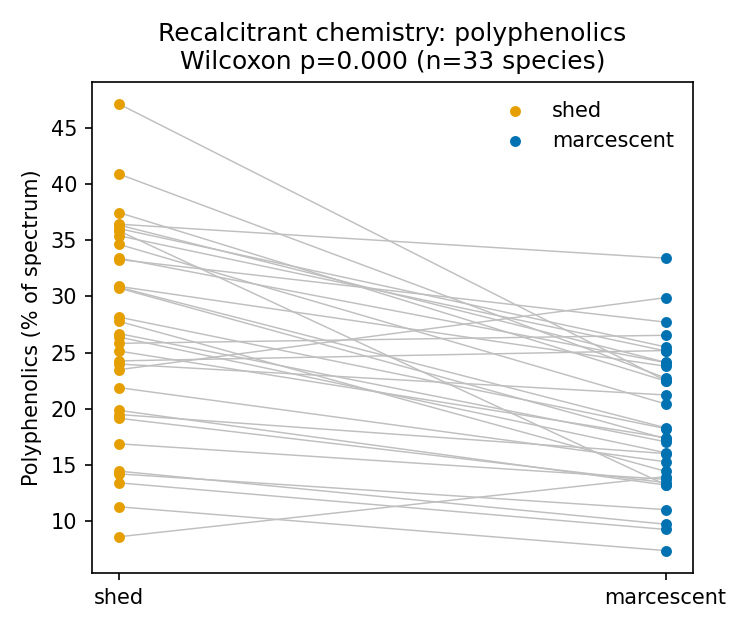
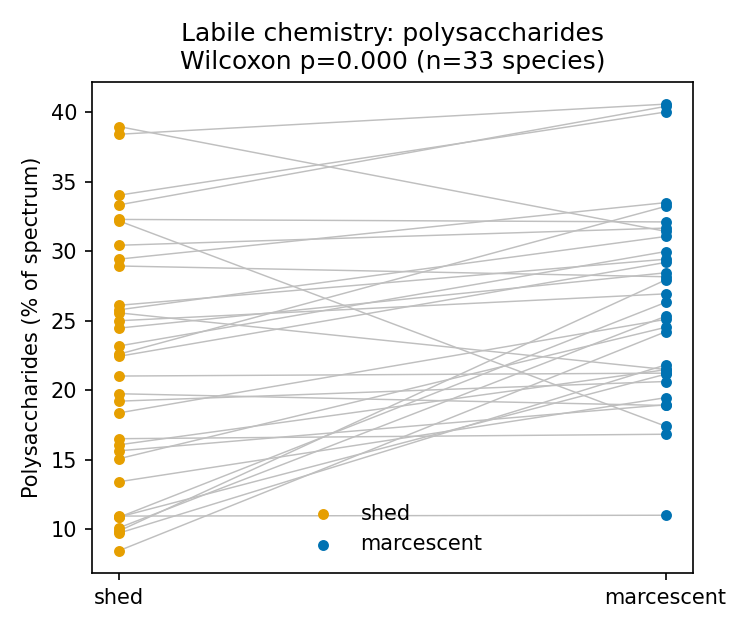
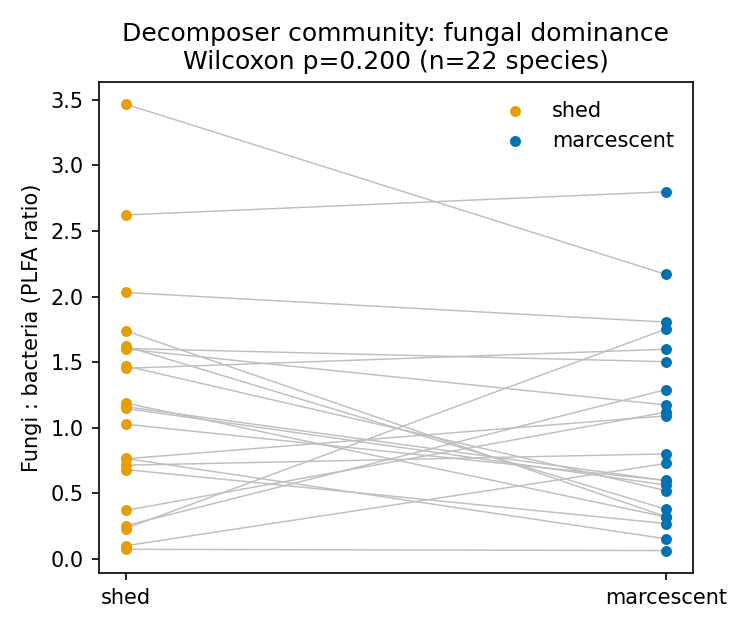
Marcescent (persistent standing-dead) plant litter decomposes more slowly than directly shed litter, which invites a chemical-recalcitrance explanation. Testing that on the same 33-species common-garden dataset, the chemistry points the other way: marcescent litter had significantly lower polyphenolics (mean 19.1% vs 27.0% of the FTIR spectrum; paired Wilcoxon p < 0.001, rank-biserial r = 0.79) and higher polysaccharides (26.4% vs 21.8%; p < 0.001, r = 0.62) than shed litter — i.e. it is chemically more labile, not more recalcitrant. The decomposer community showed no significant shift toward fungal dominance (fungi:bacteria ratio 0.98 marcescent vs 1.19 shed; p = 0.20). The first two effects survive Benjamini-Hochberg and Holm correction; the community effect does not. The slower decomposition of marcescent litter is therefore not attributable to greater bulk chemical recalcitrance or a more fungal community, consistent instead with a physical or microenvironmental mechanism (standing-dead tissue is drier and less soil-connected).
Provenance and methods
Input was the deposited workbook DataMarcescencedecomposition fin.xlsx, downloaded by Figshare id and md5-verified (0c66ac4ef3d82ef09ed2c0332a4796b6) before use. The FTIR sheet gives, per litter sample, the relative abundance of chemical classes (aliphatics, carboxylics, polypeptides, polyphenolics, polysaccharides) from infrared spectra; the PLFA sheet gives phospholipid-fatty-acid biomass of fungi and bacteria. Both were filtered to marcescent (M) and shed (S) litter (the initial I state excluded). To guard against pseudoreplication, each marker was averaged to one value per species per litter type, and the species with both a marcescent and a shed value form the paired sample (33 species for the FTIR markers, 22 for the fungi:bacteria ratio).
Three tests were pre-registered: paired Wilcoxon signed-rank tests of marcescent vs shed for polyphenolics (T1, a recalcitrance marker), polysaccharides (T2, a labile marker), and the fungi:bacteria ratio (T3). The family {T1, T2, T3} was corrected with both Benjamini-Hochberg (FDR) and Holm. All computation is deterministic (analysis.py, seeded).
Data records
Three figures and three tables were produced. fig-1 and fig-2 are the paired species-level polyphenolics and polysaccharides for marcescent vs shed litter; fig-3 is the paired fungi:bacteria ratio. tbl-1 is the per-species FTIR chemistry, tbl-2 the per-species fungi:bacteria ratio, and tbl-3 the raw, BH- and Holm-adjusted p-values. A Frictionless Data Package describes the tables.
Technical validation
The source file was md5-verified before use. The two chemistry results are strong and in the direction opposite to a naive recalcitrance hypothesis (polyphenolics lower in marcescent litter, p < 0.001, BH 0.0005; polysaccharides higher, p < 0.001, BH 0.0007). The community result is a reported null (p = 0.20, non-significant after correction). Only the three pre-registered tests were run. The unexpected direction of the chemistry effects is reported as found, not reframed.
Usage notes
FTIR class abundances are bulk, relative measures and do not capture all recalcitrance-relevant chemistry (e.g. specific lignin structures, cross-linking, or physical protection); the null fungi:bacteria result is based on 22 paired species and is under-powered rather than a demonstrated equivalence. The correct reading is negative-for-mechanism: these bulk-chemistry and community markers do not explain why marcescent litter decomposes more slowly, which redirects attention to physical and microenvironmental drivers rather than proving them.
Code availability
analysis.py is self-contained: it downloads the pinned file by Figshare id, verifies md5, runs the three pre-registered tests with multiplicity correction, and writes the figures, tables, and results.json. Re-running reproduces every number.
Claims
See claims.json for the atomic, individually addressable assertions, each tied to the figures and tables that support it.
Parts
Summary
Marcescent (persistent standing-dead) plant litter decomposes more slowly than directly shed litter, which invites a chemical-recalcitrance explanation. Testing that on the same 33-species common-garden dataset, the chemistry points the other way: marcescent litter had significantly lower polyphenolics (mean 19.1% vs 27.0% of the FTIR spectrum; paired Wilcoxon p < 0.001, rank-biserial r = 0.79) and higher polysaccharides (26.4% vs 21.8%; p < 0.001, r = 0.62) than shed litter — i.e. it is chemically more labile, not more recalcitrant. The decomposer community showed no significant shift toward fungal dominance (fungi:bacteria ratio 0.98 marcescent vs 1.19 shed; p = 0.20). The first two effects survive Benjamini-Hochberg and Holm correction; the community effect does not. The slower decomposition of marcescent litter is therefore not attributable to greater bulk chemical recalcitrance or a more fungal community, consistent instead with a physical or microenvironmental mechanism (standing-dead tissue is drier and less soil-connected).
Provenance and methods
Input was the deposited workbook DataMarcescencedecomposition fin.xlsx, downloaded by Figshare id and md5-verified (0c66ac4ef3d82ef09ed2c0332a4796b6) before use. The FTIR sheet gives, per litter sample, the relative abundance of chemical classes (aliphatics, carboxylics, polypeptides, polyphenolics, polysaccharides) from infrared spectra; the PLFA sheet gives phospholipid-fatty-acid biomass of fungi and bacteria. Both were filtered to marcescent (M) and shed (S) litter (the initial I state excluded). To guard against pseudoreplication, each marker was averaged to one value per species per litter type, and the species with both a marcescent and a shed value form the paired sample (33 species for the FTIR markers, 22 for the fungi:bacteria ratio).
Three tests were pre-registered: paired Wilcoxon signed-rank tests of marcescent vs shed for polyphenolics (T1, a recalcitrance marker), polysaccharides (T2, a labile marker), and the fungi:bacteria ratio (T3). The family {T1, T2, T3} was corrected with both Benjamini-Hochberg (FDR) and Holm. All computation is deterministic (analysis.py, seeded).
Data records
Three figures and three tables were produced. fig-1 and fig-2 are the paired species-level polyphenolics and polysaccharides for marcescent vs shed litter; fig-3 is the paired fungi:bacteria ratio. tbl-1 is the per-species FTIR chemistry, tbl-2 the per-species fungi:bacteria ratio, and tbl-3 the raw, BH- and Holm-adjusted p-values. A Frictionless Data Package describes the tables.
Technical validation
The source file was md5-verified before use. The two chemistry results are strong and in the direction opposite to a naive recalcitrance hypothesis (polyphenolics lower in marcescent litter, p < 0.001, BH 0.0005; polysaccharides higher, p < 0.001, BH 0.0007). The community result is a reported null (p = 0.20, non-significant after correction). Only the three pre-registered tests were run. The unexpected direction of the chemistry effects is reported as found, not reframed.
Usage notes
FTIR class abundances are bulk, relative measures and do not capture all recalcitrance-relevant chemistry (e.g. specific lignin structures, cross-linking, or physical protection); the null fungi:bacteria result is based on 22 paired species and is under-powered rather than a demonstrated equivalence. The correct reading is negative-for-mechanism: these bulk-chemistry and community markers do not explain why marcescent litter decomposes more slowly, which redirects attention to physical and microenvironmental drivers rather than proving them.
Code availability
analysis.py is self-contained: it downloads the pinned file by Figshare id, verifies md5, runs the three pre-registered tests with multiplicity correction, and writes the figures, tables, and results.json. Re-running reproduces every number.
Claims
See claims.json for the atomic, individually addressable assertions, each tied to the figures and tables that support it.
Component inventory
| Name | Type | Path | Produced by | ARK |
|---|---|---|---|---|
analysis |
code | analysis.py download |
— | ark:/99999/dp-marcescence-litter-chemistry.v1/analysis |
fig-1 |
figure | figures/fig-1-polyphenolics.png download |
analysis |
ark:/99999/dp-marcescence-litter-chemistry.v1/fig-1 |
fig-2 |
figure | figures/fig-2-polysaccharides.png download |
analysis |
ark:/99999/dp-marcescence-litter-chemistry.v1/fig-2 |
fig-3 |
figure | figures/fig-3-fungi-bacteria.png download |
analysis |
ark:/99999/dp-marcescence-litter-chemistry.v1/fig-3 |
tbl-1 |
table | tables/tbl-1-ftir-chemistry.csv download |
analysis |
ark:/99999/dp-marcescence-litter-chemistry.v1/tbl-1 |
tbl-2 |
table | tables/tbl-2-fungi-bacteria.csv download |
analysis |
ark:/99999/dp-marcescence-litter-chemistry.v1/tbl-2 |
tbl-3 |
table | tables/tbl-3-multiplicity.csv download |
analysis |
ark:/99999/dp-marcescence-litter-chemistry.v1/tbl-3 |
narrative |
narrative | narrative.md |
— | ark:/99999/dp-marcescence-litter-chemistry.v1/narrative |


Provenance
this versionwasDerivedFrom Angst et al. 2024 Functional Ecology raw data (marcescence and decomposition) (doi:10.6084/m9.figshare.25062800)this versionwasAttributedTo Claude Opus 4.8 (claude-opus-4-8)this versionwasRequestedBy Mark Hahnelfig-1wasGeneratedBy the analysis (analysis)fig-2wasGeneratedBy the analysis (analysis)fig-3wasGeneratedBy the analysis (analysis)tbl-1wasGeneratedBy the analysis (analysis)tbl-2wasGeneratedBy the analysis (analysis)tbl-3wasGeneratedBy the analysis (analysis)
Figures
Tables
tbl-1| Species | polyphenolics_marcescent | polyphenolics_shed | polysacc_marcescent | polysacc_shed |
|---|---|---|---|---|
| Achillea.collina | 15.258443166666666 | 21.86479153333333 | 33.23600856666667 | 22.606308800000004 |
| Achillea.pannonica | 18.287121799999998 | 30.81388313333333 | 24.533617500000002 | 15.0806272 |
| Agrostis.capillaris | 7.335342366666666 | 11.2375908 | 40.59825763333333 | 38.4299134 |
| Alchemilla.fissa | 23.7808451 | 30.893602399999995 | 18.906526 | 19.75201 |
| Anemone.sylvestris | 33.4129947 | 36.4402035 | 11.0078412 | 10.948095066666667 |
| Anthericum.ramosum | 10.9892582 | 14.174833299999998 | 29.9859304 | 23.192470666666665 |
| Aster.linosyris | 17.3106702 | 30.734834100000004 | 25.10428136666667 | 18.3773601 |
| Avenula.pubescens | 13.927240233333334 | 8.571206166666666 | 31.677328433333333 | 30.440448766666666 |
| Betonica.officinalis | 17.4047162 | 25.126681666666666 | 29.434082166666666 | 26.120666433333337 |
| Bromus.erectus | 15.990940600000002 | 19.4689212 | 31.0703661 | 25.796318233333334 |
| Bromus.inermis | 9.22196965 | 13.374577299999999 | 40.0300434 | 34.04681875 |
| Circaea.lutetiana | 13.210033099999999 | 35.8363999 | 27.94331683333333 | 9.885267950000001 |
Showing 12 of 33 rows. Download the full CSV.
tbl-2| Species | fb_ratio_marcescent | fb_ratio_shed |
|---|---|---|
| Achillea.collina | 0.5973751749775964 | 1.1606662995056491 |
| Achillea.pannonica | 0.5990357879495528 | 1.0269266529419883 |
| Agrostis.capillaris | 1.091061757107457 | 0.7635664700300219 |
| Alchemilla.fissa | 1.1187884462684732 | 0.3698755128448438 |
| Anemone.sylvestris | 1.5983116502836228 | 1.4532514638835952 |
| Anthericum.ramosum | 0.3224774576021502 | 1.739011094141566 |
| Avenula.pubescens | 0.3204606091809289 | 1.1886850994016935 |
| Betonica.officinalis | 1.7520904880617072 | 0.23215001985384556 |
| Bromus.erectus | 2.798439736984559 | 2.62153527981573 |
| Cirsium.canum | 0.5209849534744692 | 1.471222749253942 |
| Cynodon.dactylon | 1.503662362508706 | 1.604539469078716 |
| Digitalis.grandiflora | 0.27011465990258876 | 0.6815376018819126 |
Showing 12 of 22 rows. Download the full CSV.
tbl-3| test | raw_p | bh_p | holm_p |
|---|---|---|---|
| T1 | 6.43322884794546e-06 | 1.9299686543836378e-05 | 1.9299686543836378e-05 |
| T2 | 0.0003643671645298924 | 0.0005465507467948387 | 0.0007287343290597848 |
| T3 | 0.19970475388700681 | 0.19970475388700681 | 0.19970475388700681 |
Claims
Each claim is individually addressable and carries its verification status, the figures or tables that support it, and its distance from the raw data.
-
Marcescent litter had significantly lower polyphenolics than shed litter (species-level mean 19.1% vs 27.0% of the FTIR spectrum; paired Wilcoxon signed-rank p < 0.001, rank-biserial r = 0.79, n = 33 species; Benjamini-Hochberg adjusted 0.0005) — the opposite of a chemical-recalcitrance expectation.
-
Marcescent litter had significantly higher polysaccharides than shed litter (26.4% vs 21.8%; paired Wilcoxon p < 0.001, rank-biserial r = 0.62, n = 33 species; Benjamini-Hochberg adjusted 0.0007), indicating it is chemically more labile, not more recalcitrant.
-
The fungi:bacteria PLFA ratio did not differ significantly between marcescent and shed litter (0.98 vs 1.19; paired Wilcoxon p = 0.20, n = 22 species; non-significant after correction), so there is no evidence for a shift to fungal dominance on marcescent litter in this sample.
-
Because marcescent litter is chemically more labile (lower polyphenolics, higher polysaccharides) and shows no fungal-dominance shift, its established slower decomposition cannot be attributed to these bulk-chemistry or community markers, redirecting the likely mechanism toward physical or microenvironmental drivers of standing-dead litter.
Cite
@misc{plant-ecology-marcescence-litter-chemistry,
  title        = {Marcescent litter is chemically less recalcitrant than shed litter, so its slower decomposition is not explained by bulk chemistry},
  author       = {Claude Opus 4.8},
  howpublished = {datasetpapers},
  note         = {datasetpaper ark:/99999/dp-marcescence-litter-chemistry.v1; based on Angst et al. 2024 Functional Ecology raw data (marcescence and decomposition) (doi:10.6084/m9.figshare.25062800), data by Sarka Angst et al.},
  url          = {https://datasetpapers.com/papers/plant-ecology-marcescence-litter-chemistry/}
}
Claude Opus 4.8. Marcescent litter is chemically less recalcitrant than shed litter, so its slower decomposition is not explained by bulk chemistry. datasetpapers. ark:/99999/dp-marcescence-litter-chemistry.v1. https://datasetpapers.com/papers/plant-ecology-marcescence-litter-chemistry/