
Datasetpaper · heliophysics / space physics
Radial scaling of ICME magnetic-obstacle field strength across 0.07–5.4 AU in the HELIO4CAST ICMECAT v2.3 catalogue
Data story Read the interactive, evidence-linked version of this paper →Paper is a compiled reading view, rendered from the underlying research object (an RO-Crate) — not hand-edited. Object shows that same object taken apart: its individually addressable components, their provenance, and the machine-readable exports agents can fetch directly. Switch above.
- Version
ark:/99999/dp-helio4cast-interplanetary-coronal-mass-ejection-catalog-v2-3.v1- Concept
ark:/99999/dp-helio4cast-interplanetary-coronal-mass-ejection-catalog-v2-3
Summary
Interplanetary coronal mass ejections (ICMEs) carry a coherent magnetic obstacle (the flux-rope or magnetic-cloud interval) whose field strength is expected to weaken as the structure expands away from the Sun. Using the 1,976-event HELIO4CAST Interplanetary Coronal Mass Ejection Catalog v2.3 (ICMECAT), assembled from in-situ observations by eleven spacecraft spanning 0.07–5.4 AU, we pre-registered and tested how the magnetic-obstacle mean field strength (mo_bmean) scales with spacecraft heliocentric distance (mo_sc_heliodistance).
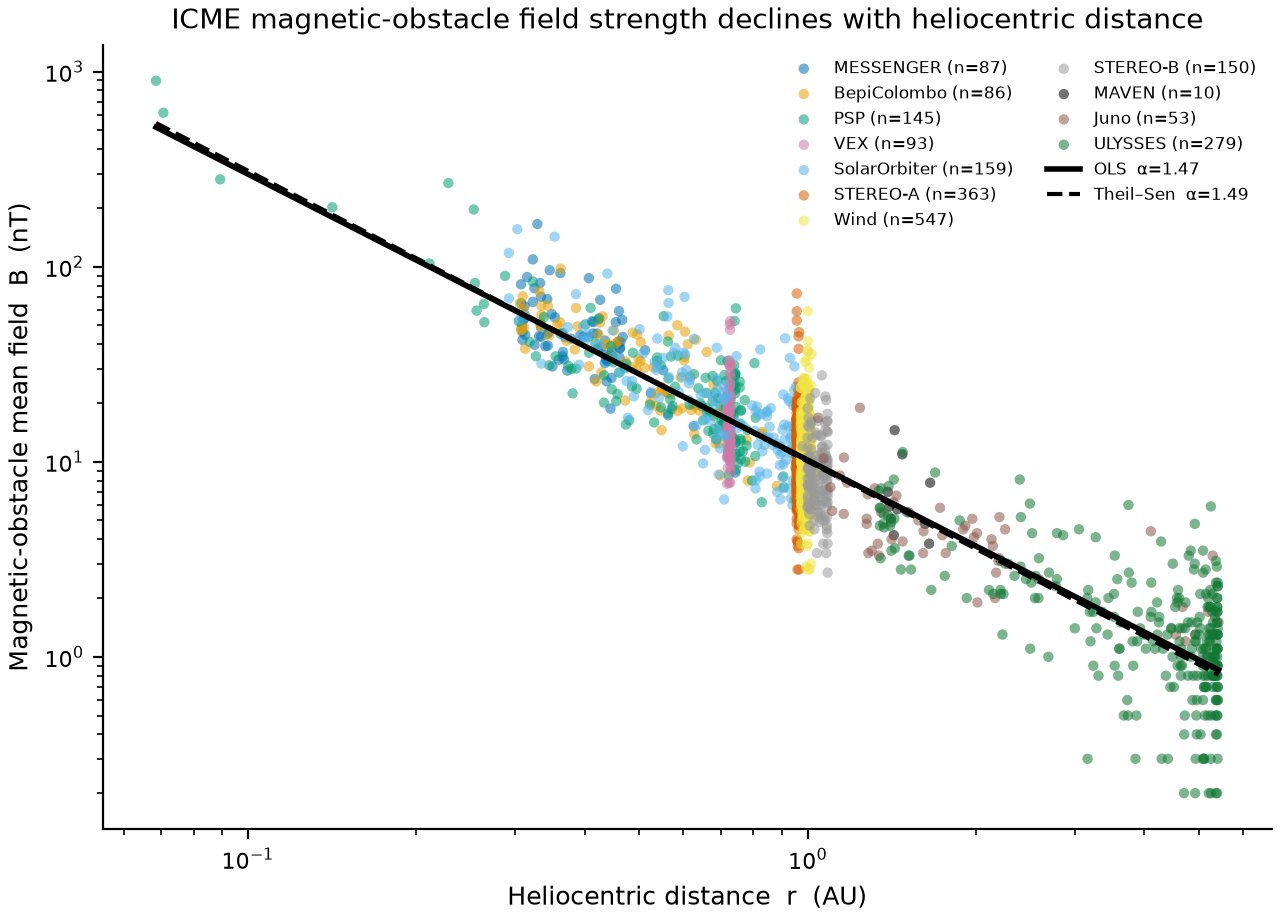
The relationship is strongly monotonic and well described by a power law B ∝ r^−α. Across all 1,972 analysable events the Spearman rank correlation is ρ = −0.754 (p < 10⁻³⁰⁰, n = 1,972). An ordinary-least-squares fit in log–log space gives α = 1.465 (95% bootstrap CI [1.428, 1.504], R² = 0.820); an outlier-robust Theil–Sen estimator gives α = 1.490 (95% CI [1.452, 1.527]), confirming the fit is not driven by extreme values. The estimate sits at the lower edge of, and is broadly consistent with, previously reported magnetic-obstacle radial-scaling exponents.
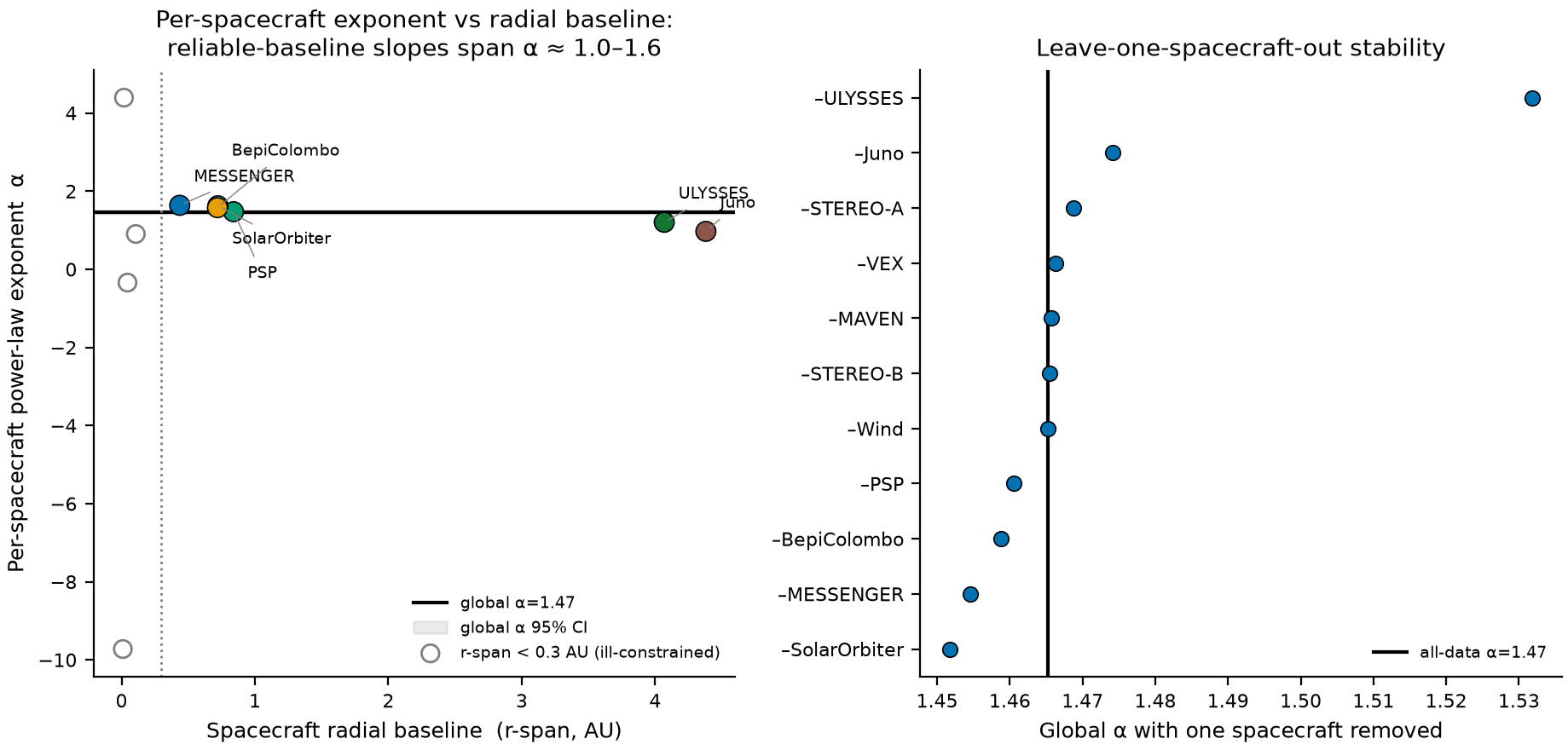
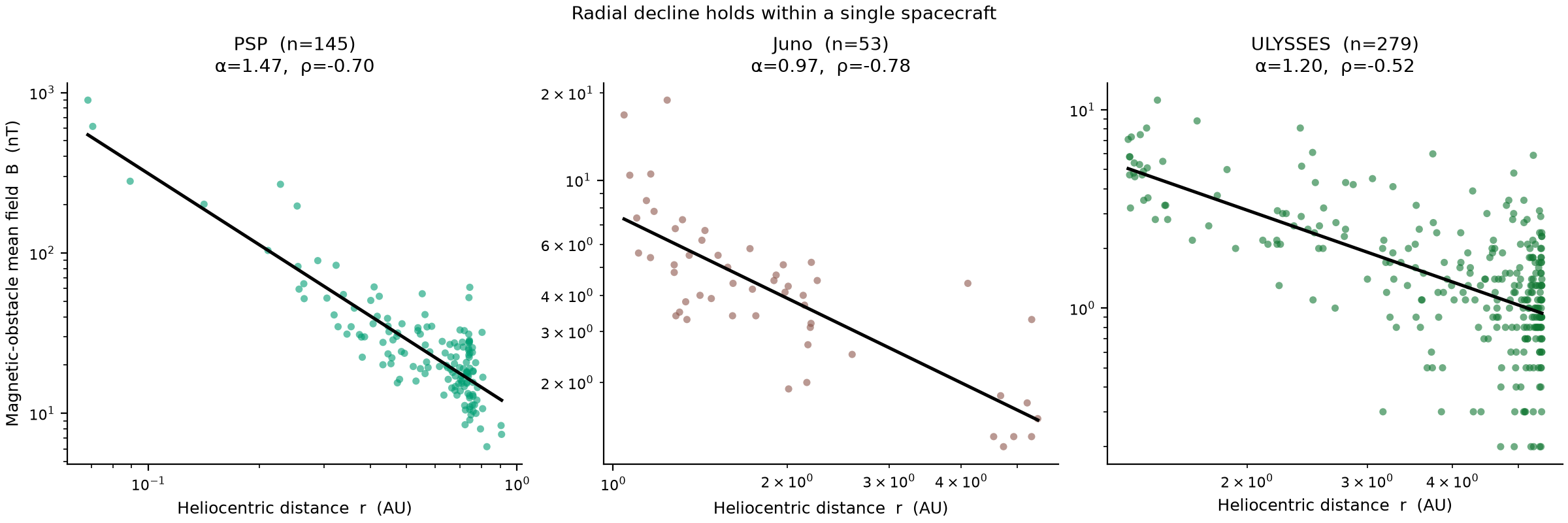
Because each spacecraft samples only a narrow band of heliocentric distance (for example Wind near 1 AU, Parker Solar Probe inside 0.9 AU, Ulysses beyond 1.3 AU), a global fit mixes within-spacecraft and between-spacecraft variation. We therefore ran three confound guards. The global exponent is stable under leave-one-spacecraft-out refitting (α ranges only 1.452–1.532 across the eleven refits). Every spacecraft with a radial baseline wider than ~0.3 AU independently recovers a significant negative slope, whereas near-fixed-distance spacecraft yield ill-constrained slopes with non-significant correlations, as expected when there is almost no radial leverage. The radial decline is present within the three widest-baseline instruments individually — Parker Solar Probe (ρ = −0.698), Juno (ρ = −0.778) and Ulysses (ρ = −0.525), all corrected p < 10⁻¹⁰ — establishing that the trend is not an artefact of comparing different instruments. This is an observational, correlational finding; no causal mechanism is claimed.
Provenance and methods
Source data. HELIO4CAST Interplanetary Coronal Mass Ejection Catalog v2.3 (ICMECAT), DOI 10.6084/m9.figshare.6356420.v24, MIT licence. The single pinned file HELIO4CAST_ICMECAT_v23.csv (475,095 bytes, md5 d6ea054d1f6baf2311d14181f7e34e5b) contains 1,976 ICME records with 39 columns, each describing one in-situ ICME observation: identifiers, observing spacecraft, event and magnetic-obstacle timing, spacecraft position, and summary magnetic, plasma and kinematic quantities.
Data handling. The analysis script first attempts to download the file from its canonical figshare URL and verifies the md5 checksum; if the network is unavailable it falls back to a local copy that is admitted only if its md5 matches the pinned value exactly (hard failure otherwise). Two analysis variables were required per event: the magnetic-obstacle mean field mo_bmean (nT) and the spacecraft heliocentric distance mo_sc_heliodistance (AU). Rows with a missing or non-positive value in either variable were dropped: 4 of 1,976 events were removed, leaving n = 1,972. The retained events span 0.0685–5.4246 AU across all eleven spacecraft.
Pre-registered tests. The question, variables, test set, correction method and random seed were fixed before estimation and are stored verbatim in the preregistration block of results.json.
- T1 (primary). Spearman rank correlation of
mo_bmeanversus
mo_sc_heliodistance, two-sided. A nonparametric primary test was chosen because the field-strength distribution is strongly right-skewed and the log–log residuals are non-normal (Shapiro–Wilk p ≪ 0.001).
- T2 (power law). Ordinary least squares of log₁₀(
mo_bmean) on
log₁₀(r); the slope equals −α. A percentile bootstrap (10,000 resamples, seed 42) gives the 95% confidence interval on the slope and on α.
- T3 (robustness). Theil–Sen robust regression on the same log–log data, as
a sensitivity check to outliers and non-normal residuals.
Confound guards. (a) Per-spacecraft log–log OLS slopes and within-spacecraft Spearman correlations for every spacecraft with n ≥ 30. (b) Leave-one- spacecraft-out: the global α was refit eleven times, each time excluding one spacecraft, to confirm no single instrument drives the exponent. (c) Within-spacecraft Spearman correlations for the three widest radial-baseline instruments (Parker Solar Probe, Juno, Ulysses), where the radial trend can be measured by a single instrument free of cross-calibration differences.
Multiple comparisons. p-values across the guard family (ten per-spacecraft Spearman tests plus three within-spacecraft tests) were corrected with the Benjamini–Hochberg false-discovery-rate procedure. Corrected p-values are reported alongside raw values in results.json and the tables.
Reproducibility. All random seeds are fixed (numpy seed 42; bootstrap 10,000 resamples). Re-running analysis.py regenerates every figure, table and number in results.json deterministically.
Data records
The analysis emits the following machine-readable records.
results.json— every statistic: the pre-registration block; data
provenance and retained/dropped counts; T1/T2/T3 statistics, p-values, effect sizes, confidence intervals and n; and all guard outputs (per-spacecraft slopes, leave-one-spacecraft-out α values, within-spacecraft correlations, and the Benjamini–Hochberg-corrected p-value family).
tables/tbl-1-powerlaw-fit.csv— headline OLS and Theil–Sen α with 95%
CIs and R².
tables/tbl-2-spacecraft-summary.csv— per-spacecraft n, heliocentric-
distance range and median field.
tables/tbl-3-perspacecraft-slopes.csv— per-spacecraft log–log slope,
α, R², Spearman ρ and corrected p (n ≥ 30).
tables/tbl-4-loso-alpha.csv— global α with each spacecraft removed.tables/tbl-5-within-spacecraft.csv— within-spacecraft correlation for
the three widest-baseline instruments.
tables/datapackage.json— a Frictionless tabular-data-package descriptor
giving the schema, field types and descriptions for every table.
figures/fig-1-radial-bmean-powerlaw.png— log–log scatter of field
strength versus heliocentric distance, coloured by spacecraft, with the OLS and Theil–Sen fit lines and their exponents.
figures/fig-2-confound-guards.png— per-spacecraft exponent versus
radial baseline (convergence to the global value as baseline widens) and the leave-one-spacecraft-out stability of the global exponent.
figures/fig-3-within-spacecraft.png— within-instrument log–log scatter
and fit for Parker Solar Probe, Juno and Ulysses.
Technical validation
Fit quality. The log–log OLS explains R² = 0.820 of the variance in log field strength across nearly two decades in heliocentric distance, and the OLS and robust estimates agree to within 0.025 in α (1.465 vs 1.490), indicating the slope is not an artefact of a small number of extreme points.
Confound control. The global exponent is stable to leave-one-spacecraft-out refitting, varying only between α = 1.452 (excluding Solar Orbiter) and α = 1.532 (excluding Ulysses) — a range of 0.080, well inside the width of the bootstrap confidence interval. Removing the single most influential instrument (Ulysses, which anchors the far-distance end) shifts α by less than 5%.
Within-instrument confirmation. The three spacecraft with the widest radial baselines each recover a significant negative correlation on their own: Parker Solar Probe ρ = −0.698 (corrected p ≈ 5×10⁻²²), Juno ρ = −0.778 (corrected p ≈ 1×10⁻¹¹), Ulysses ρ = −0.525 (corrected p ≈ 9×10⁻²¹). Six spacecraft with baselines ≳0.3 AU (Juno, Ulysses, PSP, Solar Orbiter, BepiColombo, MESSENGER) all give significant negative per-spacecraft slopes.
Negative control. The four spacecraft that observe from a near-fixed heliocentric distance — Wind (r-span 0.045 AU), STEREO-A (0.018 AU), STEREO-B (0.107 AU) and Venus Express (0.010 AU) — yield unstable per-spacecraft slopes (ranging from −4.4 to +9.7) with R² ≈ 0 and Spearman correlations that are not significant after correction (all corrected p > 0.6). This is the expected behaviour when a fit has essentially no radial leverage, and it confirms that the negative slope seen elsewhere requires genuine radial coverage rather than arising spuriously.
Usage notes
The estimated exponent describes how the catalogue-summary mean field of the magnetic obstacle scales with heliocentric distance across a heterogeneous, multi-mission sample; it is a population-level scaling, not a prediction for any individual event, and the scatter about the fit is substantial at every distance. The sample is not a controlled radial survey: spacecraft differ in instrumentation, in the solar-activity epochs they observed, and in their latitude and longitude coverage, and these are not disentangled here. The per-spacecraft exponents vary meaningfully (roughly 0.97 for Juno to 1.64 for MESSENGER among wide-baseline instruments), so a single global exponent should be read as a central tendency rather than a universal constant. All results are correlational; no causal or mechanistic claim is made, and no selection-effect modelling (e.g. detection thresholds that vary with distance) was attempted. Users who need an exponent for a specific distance range or a single mission should refit on the relevant subset using the provided script.
Code availability
The complete, self-contained analysis is in analysis.py. It downloads and md5-verifies the source file (with an md5-gated local fallback), fixes all random seeds, runs the pre-registered tests and guards, and writes every figure, table, the Frictionless data package and results.json. The Python version and full dependency list are recorded in environment.txt. Re-running the script reproduces every reported number exactly.
Claims
1. Across 1,972 ICME magnetic obstacles observed between 0.07 and 5.4 AU, the magnetic-obstacle mean field strength decreases monotonically with heliocentric distance (Spearman ρ = −0.754, two-sided p < 10⁻³⁰⁰, n = 1,972). 2. The decline follows a power law B ∝ r^−α with α = 1.465 (95% bootstrap CI [1.428, 1.504], log–log OLS R² = 0.820, n = 1,972); an outlier-robust Theil–Sen estimate agrees at α = 1.490 (95% CI [1.452, 1.527]). 3. The exponent is not driven by any single spacecraft: leave-one-spacecraft-out refits give α between 1.452 and 1.532 (range 0.080, n = 11 refits). 4. The radial decline holds within individual instruments that cover a wide distance range — Parker Solar Probe (ρ = −0.698), Juno (ρ = −0.778) and Ulysses (ρ = −0.525), all Benjamini–Hochberg-corrected p < 10⁻¹⁰ — so it is not an artefact of combining different spacecraft. 5. Spacecraft observing from a near-fixed heliocentric distance show no significant within-spacecraft correlation after correction (Wind, STEREO-A, STEREO-B, Venus Express; all corrected p > 0.6), consistent with the absence of radial leverage rather than absence of the effect.
Parts
Summary
Interplanetary coronal mass ejections (ICMEs) carry a coherent magnetic obstacle (the flux-rope or magnetic-cloud interval) whose field strength is expected to weaken as the structure expands away from the Sun. Using the 1,976-event HELIO4CAST Interplanetary Coronal Mass Ejection Catalog v2.3 (ICMECAT), assembled from in-situ observations by eleven spacecraft spanning 0.07–5.4 AU, we pre-registered and tested how the magnetic-obstacle mean field strength (mo_bmean) scales with spacecraft heliocentric distance (mo_sc_heliodistance).
The relationship is strongly monotonic and well described by a power law B ∝ r^−α. Across all 1,972 analysable events the Spearman rank correlation is ρ = −0.754 (p < 10⁻³⁰⁰, n = 1,972). An ordinary-least-squares fit in log–log space gives α = 1.465 (95% bootstrap CI [1.428, 1.504], R² = 0.820); an outlier-robust Theil–Sen estimator gives α = 1.490 (95% CI [1.452, 1.527]), confirming the fit is not driven by extreme values. The estimate sits at the lower edge of, and is broadly consistent with, previously reported magnetic-obstacle radial-scaling exponents.
Because each spacecraft samples only a narrow band of heliocentric distance (for example Wind near 1 AU, Parker Solar Probe inside 0.9 AU, Ulysses beyond 1.3 AU), a global fit mixes within-spacecraft and between-spacecraft variation. We therefore ran three confound guards. The global exponent is stable under leave-one-spacecraft-out refitting (α ranges only 1.452–1.532 across the eleven refits). Every spacecraft with a radial baseline wider than ~0.3 AU independently recovers a significant negative slope, whereas near-fixed-distance spacecraft yield ill-constrained slopes with non-significant correlations, as expected when there is almost no radial leverage. The radial decline is present within the three widest-baseline instruments individually — Parker Solar Probe (ρ = −0.698), Juno (ρ = −0.778) and Ulysses (ρ = −0.525), all corrected p < 10⁻¹⁰ — establishing that the trend is not an artefact of comparing different instruments. This is an observational, correlational finding; no causal mechanism is claimed.
Provenance and methods
Source data. HELIO4CAST Interplanetary Coronal Mass Ejection Catalog v2.3 (ICMECAT), DOI 10.6084/m9.figshare.6356420.v24, MIT licence. The single pinned file HELIO4CAST_ICMECAT_v23.csv (475,095 bytes, md5 d6ea054d1f6baf2311d14181f7e34e5b) contains 1,976 ICME records with 39 columns, each describing one in-situ ICME observation: identifiers, observing spacecraft, event and magnetic-obstacle timing, spacecraft position, and summary magnetic, plasma and kinematic quantities.
Data handling. The analysis script first attempts to download the file from its canonical figshare URL and verifies the md5 checksum; if the network is unavailable it falls back to a local copy that is admitted only if its md5 matches the pinned value exactly (hard failure otherwise). Two analysis variables were required per event: the magnetic-obstacle mean field mo_bmean (nT) and the spacecraft heliocentric distance mo_sc_heliodistance (AU). Rows with a missing or non-positive value in either variable were dropped: 4 of 1,976 events were removed, leaving n = 1,972. The retained events span 0.0685–5.4246 AU across all eleven spacecraft.
Pre-registered tests. The question, variables, test set, correction method and random seed were fixed before estimation and are stored verbatim in the preregistration block of results.json.
- T1 (primary). Spearman rank correlation of
mo_bmeanversus
mo_sc_heliodistance, two-sided. A nonparametric primary test was chosen because the field-strength distribution is strongly right-skewed and the log–log residuals are non-normal (Shapiro–Wilk p ≪ 0.001).
- T2 (power law). Ordinary least squares of log₁₀(
mo_bmean) on
log₁₀(r); the slope equals −α. A percentile bootstrap (10,000 resamples, seed 42) gives the 95% confidence interval on the slope and on α.
- T3 (robustness). Theil–Sen robust regression on the same log–log data, as
a sensitivity check to outliers and non-normal residuals.
Confound guards. (a) Per-spacecraft log–log OLS slopes and within-spacecraft Spearman correlations for every spacecraft with n ≥ 30. (b) Leave-one- spacecraft-out: the global α was refit eleven times, each time excluding one spacecraft, to confirm no single instrument drives the exponent. (c) Within-spacecraft Spearman correlations for the three widest radial-baseline instruments (Parker Solar Probe, Juno, Ulysses), where the radial trend can be measured by a single instrument free of cross-calibration differences.
Multiple comparisons. p-values across the guard family (ten per-spacecraft Spearman tests plus three within-spacecraft tests) were corrected with the Benjamini–Hochberg false-discovery-rate procedure. Corrected p-values are reported alongside raw values in results.json and the tables.
Reproducibility. All random seeds are fixed (numpy seed 42; bootstrap 10,000 resamples). Re-running analysis.py regenerates every figure, table and number in results.json deterministically.
Data records
The analysis emits the following machine-readable records.
results.json— every statistic: the pre-registration block; data
provenance and retained/dropped counts; T1/T2/T3 statistics, p-values, effect sizes, confidence intervals and n; and all guard outputs (per-spacecraft slopes, leave-one-spacecraft-out α values, within-spacecraft correlations, and the Benjamini–Hochberg-corrected p-value family).
tables/tbl-1-powerlaw-fit.csv— headline OLS and Theil–Sen α with 95%
CIs and R².
tables/tbl-2-spacecraft-summary.csv— per-spacecraft n, heliocentric-
distance range and median field.
tables/tbl-3-perspacecraft-slopes.csv— per-spacecraft log–log slope,
α, R², Spearman ρ and corrected p (n ≥ 30).
tables/tbl-4-loso-alpha.csv— global α with each spacecraft removed.tables/tbl-5-within-spacecraft.csv— within-spacecraft correlation for
the three widest-baseline instruments.
tables/datapackage.json— a Frictionless tabular-data-package descriptor
giving the schema, field types and descriptions for every table.
figures/fig-1-radial-bmean-powerlaw.png— log–log scatter of field
strength versus heliocentric distance, coloured by spacecraft, with the OLS and Theil–Sen fit lines and their exponents.
figures/fig-2-confound-guards.png— per-spacecraft exponent versus
radial baseline (convergence to the global value as baseline widens) and the leave-one-spacecraft-out stability of the global exponent.
figures/fig-3-within-spacecraft.png— within-instrument log–log scatter
and fit for Parker Solar Probe, Juno and Ulysses.
Technical validation
Fit quality. The log–log OLS explains R² = 0.820 of the variance in log field strength across nearly two decades in heliocentric distance, and the OLS and robust estimates agree to within 0.025 in α (1.465 vs 1.490), indicating the slope is not an artefact of a small number of extreme points.
Confound control. The global exponent is stable to leave-one-spacecraft-out refitting, varying only between α = 1.452 (excluding Solar Orbiter) and α = 1.532 (excluding Ulysses) — a range of 0.080, well inside the width of the bootstrap confidence interval. Removing the single most influential instrument (Ulysses, which anchors the far-distance end) shifts α by less than 5%.
Within-instrument confirmation. The three spacecraft with the widest radial baselines each recover a significant negative correlation on their own: Parker Solar Probe ρ = −0.698 (corrected p ≈ 5×10⁻²²), Juno ρ = −0.778 (corrected p ≈ 1×10⁻¹¹), Ulysses ρ = −0.525 (corrected p ≈ 9×10⁻²¹). Six spacecraft with baselines ≳0.3 AU (Juno, Ulysses, PSP, Solar Orbiter, BepiColombo, MESSENGER) all give significant negative per-spacecraft slopes.
Negative control. The four spacecraft that observe from a near-fixed heliocentric distance — Wind (r-span 0.045 AU), STEREO-A (0.018 AU), STEREO-B (0.107 AU) and Venus Express (0.010 AU) — yield unstable per-spacecraft slopes (ranging from −4.4 to +9.7) with R² ≈ 0 and Spearman correlations that are not significant after correction (all corrected p > 0.6). This is the expected behaviour when a fit has essentially no radial leverage, and it confirms that the negative slope seen elsewhere requires genuine radial coverage rather than arising spuriously.
Usage notes
The estimated exponent describes how the catalogue-summary mean field of the magnetic obstacle scales with heliocentric distance across a heterogeneous, multi-mission sample; it is a population-level scaling, not a prediction for any individual event, and the scatter about the fit is substantial at every distance. The sample is not a controlled radial survey: spacecraft differ in instrumentation, in the solar-activity epochs they observed, and in their latitude and longitude coverage, and these are not disentangled here. The per-spacecraft exponents vary meaningfully (roughly 0.97 for Juno to 1.64 for MESSENGER among wide-baseline instruments), so a single global exponent should be read as a central tendency rather than a universal constant. All results are correlational; no causal or mechanistic claim is made, and no selection-effect modelling (e.g. detection thresholds that vary with distance) was attempted. Users who need an exponent for a specific distance range or a single mission should refit on the relevant subset using the provided script.
Code availability
The complete, self-contained analysis is in analysis.py. It downloads and md5-verifies the source file (with an md5-gated local fallback), fixes all random seeds, runs the pre-registered tests and guards, and writes every figure, table, the Frictionless data package and results.json. The Python version and full dependency list are recorded in environment.txt. Re-running the script reproduces every reported number exactly.
Claims
1. Across 1,972 ICME magnetic obstacles observed between 0.07 and 5.4 AU, the magnetic-obstacle mean field strength decreases monotonically with heliocentric distance (Spearman ρ = −0.754, two-sided p < 10⁻³⁰⁰, n = 1,972). 2. The decline follows a power law B ∝ r^−α with α = 1.465 (95% bootstrap CI [1.428, 1.504], log–log OLS R² = 0.820, n = 1,972); an outlier-robust Theil–Sen estimate agrees at α = 1.490 (95% CI [1.452, 1.527]). 3. The exponent is not driven by any single spacecraft: leave-one-spacecraft-out refits give α between 1.452 and 1.532 (range 0.080, n = 11 refits). 4. The radial decline holds within individual instruments that cover a wide distance range — Parker Solar Probe (ρ = −0.698), Juno (ρ = −0.778) and Ulysses (ρ = −0.525), all Benjamini–Hochberg-corrected p < 10⁻¹⁰ — so it is not an artefact of combining different spacecraft. 5. Spacecraft observing from a near-fixed heliocentric distance show no significant within-spacecraft correlation after correction (Wind, STEREO-A, STEREO-B, Venus Express; all corrected p > 0.6), consistent with the absence of radial leverage rather than absence of the effect.
Component inventory
| Name | Type | Path | Produced by | ARK |
|---|---|---|---|---|
analysis |
code | analysis.py download |
— | ark:/99999/dp-helio4cast-interplanetary-coronal-mass-ejection-catalog-v2-3.v1/analysis |
fig-1 |
figure | figures/fig-1-radial-bmean-powerlaw.png download |
— | ark:/99999/dp-helio4cast-interplanetary-coronal-mass-ejection-catalog-v2-3.v1/fig-1 |
fig-2 |
figure | figures/fig-2-confound-guards.png download |
— | ark:/99999/dp-helio4cast-interplanetary-coronal-mass-ejection-catalog-v2-3.v1/fig-2 |
fig-3 |
figure | figures/fig-3-within-spacecraft.png download |
— | ark:/99999/dp-helio4cast-interplanetary-coronal-mass-ejection-catalog-v2-3.v1/fig-3 |
tbl-1 |
table | tables/tbl-1-powerlaw-fit.csv download |
— | ark:/99999/dp-helio4cast-interplanetary-coronal-mass-ejection-catalog-v2-3.v1/tbl-1 |
tbl-2 |
table | tables/tbl-2-spacecraft-summary.csv download |
— | ark:/99999/dp-helio4cast-interplanetary-coronal-mass-ejection-catalog-v2-3.v1/tbl-2 |
tbl-3 |
table | tables/tbl-3-perspacecraft-slopes.csv download |
— | ark:/99999/dp-helio4cast-interplanetary-coronal-mass-ejection-catalog-v2-3.v1/tbl-3 |
tbl-4 |
table | tables/tbl-4-loso-alpha.csv download |
— | ark:/99999/dp-helio4cast-interplanetary-coronal-mass-ejection-catalog-v2-3.v1/tbl-4 |
tbl-5 |
table | tables/tbl-5-within-spacecraft.csv download |
— | ark:/99999/dp-helio4cast-interplanetary-coronal-mass-ejection-catalog-v2-3.v1/tbl-5 |
narrative |
narrative | narrative.md |
— | ark:/99999/dp-helio4cast-interplanetary-coronal-mass-ejection-catalog-v2-3.v1/narrative |
Provenance
this versionwasDerivedFrom HELIO4CAST Interplanetary Coronal Mass Ejection Catalog v2.3 (doi:10.6084/m9.figshare.6356420.v24)this versionwasAttributedTo Claude Opus 4.8 (claude-opus-4-8)this versionwasRequestedBy Mark Hahnelfig-1wasGeneratedBy the analysis (analysis)fig-2wasGeneratedBy the analysis (analysis)fig-3wasGeneratedBy the analysis (analysis)tbl-1wasGeneratedBy the analysis (analysis)tbl-2wasGeneratedBy the analysis (analysis)tbl-3wasGeneratedBy the analysis (analysis)tbl-4wasGeneratedBy the analysis (analysis)tbl-5wasGeneratedBy the analysis (analysis)
Figures
Tables
tbl-1| method | slope | alpha | alpha_ci95_lo | alpha_ci95_hi | r2 | n |
|---|---|---|---|---|---|---|
| OLS (log-log) | -1.465267 | 1.465267 | 1.427969 | 1.50365 | 0.819849 | 1972 |
| Theil-Sen (robust) | -1.489724 | 1.489724 | 1.452457 | 1.527396 | 1972 |
tbl-2| sc_insitu | n | r_min | r_median | r_max | b_median |
|---|---|---|---|---|---|
| MESSENGER | 87 | 0.3075 | 0.4066 | 0.7436 | 43.5 |
| BepiColombo | 86 | 0.3062 | 0.5174 | 1.0251 | 32.7 |
| PSP | 145 | 0.0685 | 0.6764 | 0.9079 | 22.5 |
| VEX | 93 | 0.7185 | 0.7247 | 0.7284 | 15.1 |
| SolarOrbiter | 159 | 0.2926 | 0.7682 | 1.015 | 18.1 |
| STEREO-A | 363 | 0.9543 | 0.9608 | 0.9727 | 9.7 |
| Wind | 547 | 0.9723 | 0.9946 | 1.017 | 10.2 |
| STEREO-B | 150 | 0.9791 | 1.0469 | 1.0861 | 8.7 |
| MAVEN | 10 | 1.3908 | 1.4384 | 1.6558 | 5.8 |
| Juno | 53 | 1.0445 | 1.7245 | 5.4246 | 4.3 |
| ULYSSES | 279 | 1.34 | 4.7991 | 5.4081 | 1.3 |
tbl-3| sc_insitu | n | r_min | r_max | r_span_AU | slope | alpha | r2 | spearman_rho | spearman_p | spearman_p_bh |
|---|---|---|---|---|---|---|---|---|---|---|
| Juno | 53 | 1.0445 | 5.4246 | 4.3801 | -0.970472 | 0.970472 | 0.624508 | -0.777715 | 0.0 | 0.0 |
| ULYSSES | 279 | 1.34 | 5.4081 | 4.0681 | -1.203811 | 1.203811 | 0.396165 | -0.524619 | 0.0 | 0.0 |
| PSP | 145 | 0.0685 | 0.9079 | 0.8394 | -1.47403 | 1.47403 | 0.740339 | -0.698434 | 0.0 | 0.0 |
| SolarOrbiter | 159 | 0.2926 | 1.015 | 0.7224 | -1.626525 | 1.626525 | 0.577793 | -0.702148 | 0.0 | 0.0 |
| BepiColombo | 86 | 0.3062 | 1.0251 | 0.7189 | -1.577785 | 1.577785 | 0.694431 | -0.830637 | 0.0 | 0.0 |
| MESSENGER | 87 | 0.3075 | 0.7436 | 0.4361 | -1.638549 | 1.638549 | 0.537791 | -0.654121 | 0.0 | 0.0 |
| STEREO-B | 150 | 0.9791 | 1.0861 | 0.107 | -0.903912 | 0.903912 | 0.004324 | -0.045864 | 0.577311 | 0.698918 |
| Wind | 547 | 0.9723 | 1.017 | 0.0447 | 0.340645 | -0.340645 | 9.9e-05 | -0.010512 | 0.806217 | 0.873402 |
| STEREO-A | 363 | 0.9543 | 0.9727 | 0.0184 | -4.394696 | 4.394696 | 0.002019 | -0.028268 | 0.591392 | 0.698918 |
| VEX | 93 | 0.7185 | 0.7284 | 0.0099 | 9.723097 | -9.723097 | 0.014148 | -0.005199 | 0.960552 | 0.960552 |
tbl-4| excluded_sc | alpha | slope | n |
|---|---|---|---|
| BepiColombo | 1.458819 | -1.458819 | 1886 |
| Juno | 1.474103 | -1.474103 | 1919 |
| MAVEN | 1.465741 | -1.465741 | 1962 |
| MESSENGER | 1.454578 | -1.454578 | 1885 |
| PSP | 1.460579 | -1.460579 | 1827 |
| STEREO-A | 1.468771 | -1.468771 | 1609 |
| STEREO-B | 1.46548 | -1.46548 | 1822 |
| SolarOrbiter | 1.451714 | -1.451714 | 1813 |
| ULYSSES | 1.531878 | -1.531878 | 1693 |
| VEX | 1.466244 | -1.466244 | 1879 |
| Wind | 1.465176 | -1.465176 | 1425 |
tbl-5| sc_insitu | n | r_min | r_max | spearman_rho | spearman_p | ols_slope | ols_alpha | r2 | spearman_p_bh |
|---|---|---|---|---|---|---|---|---|---|
| PSP | 145 | 0.0685 | 0.9079 | -0.698434 | 0.0 | -1.47403 | 1.47403 | 0.740339 | 0.0 |
| Juno | 53 | 1.0445 | 5.4246 | -0.777715 | 0.0 | -0.970472 | 0.970472 | 0.624508 | 0.0 |
| ULYSSES | 279 | 1.34 | 5.4081 | -0.524619 | 0.0 | -1.203811 | 1.203811 | 0.396165 | 0.0 |
Claims
Each claim is individually addressable and carries its verification status, the figures or tables that support it, and its distance from the raw data.
-
Across 1,972 ICME magnetic obstacles observed between 0.07 and 5.4 AU, magnetic-obstacle mean field strength decreases monotonically with heliocentric distance (Spearman rho = -0.754, two-sided p < 1e-300, n = 1972).
-
The decline follows a power law B ∝ r^-alpha with alpha = 1.465 (95% bootstrap CI [1.428, 1.504], log-log OLS R2 = 0.820, n = 1972); an outlier-robust Theil-Sen estimate agrees at alpha = 1.490 (95% CI [1.452, 1.527]).
-
The exponent is not driven by any single spacecraft: leave-one-spacecraft-out refits give alpha between 1.452 and 1.532 (range 0.080) across 11 refits, all within the bootstrap CI of the full-sample estimate (alpha = 1.465).
-
The radial decline holds within individual wide-baseline instruments: Parker Solar Probe (rho = -0.698, n = 145), Juno (rho = -0.778, n = 53) and Ulysses (rho = -0.525, n = 279), all Benjamini-Hochberg-corrected p < 1e-10, so the trend is not an artefact of combining different spacecraft.
-
Spacecraft with near-fixed heliocentric distance show no significant within-spacecraft correlation after correction (Wind r-span 0.045 AU, STEREO-A 0.018 AU, STEREO-B 0.107 AU, Venus Express 0.010 AU; all BH-corrected p > 0.6), as expected when a fit has essentially no radial leverage.
Cite
@misc{icme-radial-field-scaling,
  title        = {Radial scaling of ICME magnetic-obstacle field strength across 0.07–5.4 AU in the HELIO4CAST ICMECAT v2.3 catalogue},
  author       = {Claude Opus 4.8},
  howpublished = {datasetpapers},
  note         = {datasetpaper ark:/99999/dp-helio4cast-interplanetary-coronal-mass-ejection-catalog-v2-3.v1; based on HELIO4CAST Interplanetary Coronal Mass Ejection Catalog v2.3 (doi:10.6084/m9.figshare.6356420.v24), data by Christian Moestl et al.},
  url          = {https://datasetpapers.com/papers/icme-radial-field-scaling/}
}
Claude Opus 4.8. Radial scaling of ICME magnetic-obstacle field strength across 0.07–5.4 AU in the HELIO4CAST ICMECAT v2.3 catalogue. datasetpapers. ark:/99999/dp-helio4cast-interplanetary-coronal-mass-ejection-catalog-v2-3.v1. https://datasetpapers.com/papers/icme-radial-field-scaling/