
Datasetpaper · Environmental science / river restoration
Do dam structural dimensions predict upstream river miles reconnected?
Data story Read the interactive, evidence-linked version of this paper →Paper is a compiled reading view, rendered from the underlying research object (an RO-Crate) — not hand-edited. Object shows that same object taken apart: its individually addressable components, their provenance, and the machine-readable exports agents can fetch directly. Switch above.
- Version
ark:/99999/dp-american-rivers-dam-removal-database.v1- Concept
ark:/99999/dp-american-rivers-dam-removal-database- Source dataset
- American Rivers Dam Removal Database
Summary
Using the American Rivers Dam Removal Database (2,325 removed dams), we asked whether two structural dimensions of a removed dam — its height and its length — are associated with the length of upstream river reconnected by the removal (Miles_Restored_US). Both associations are, at most, weak.
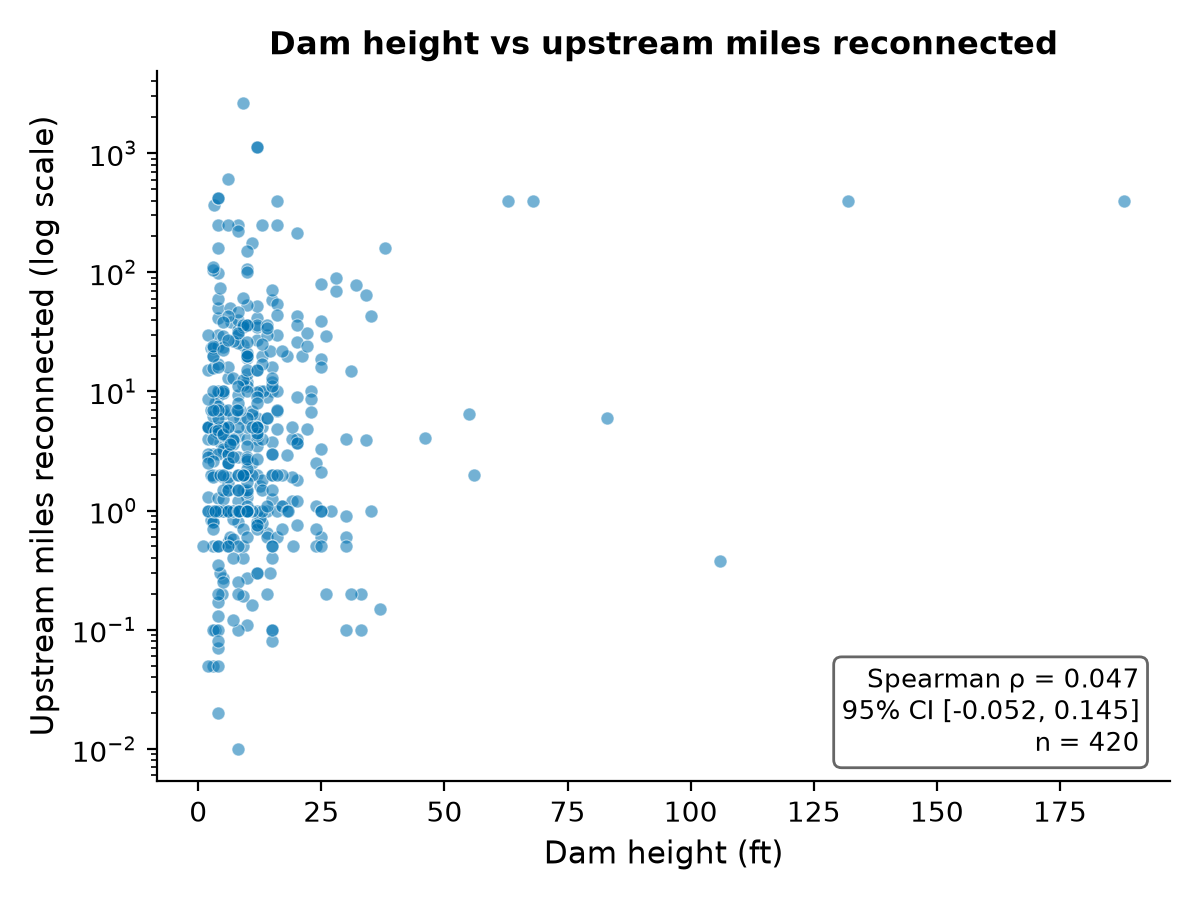
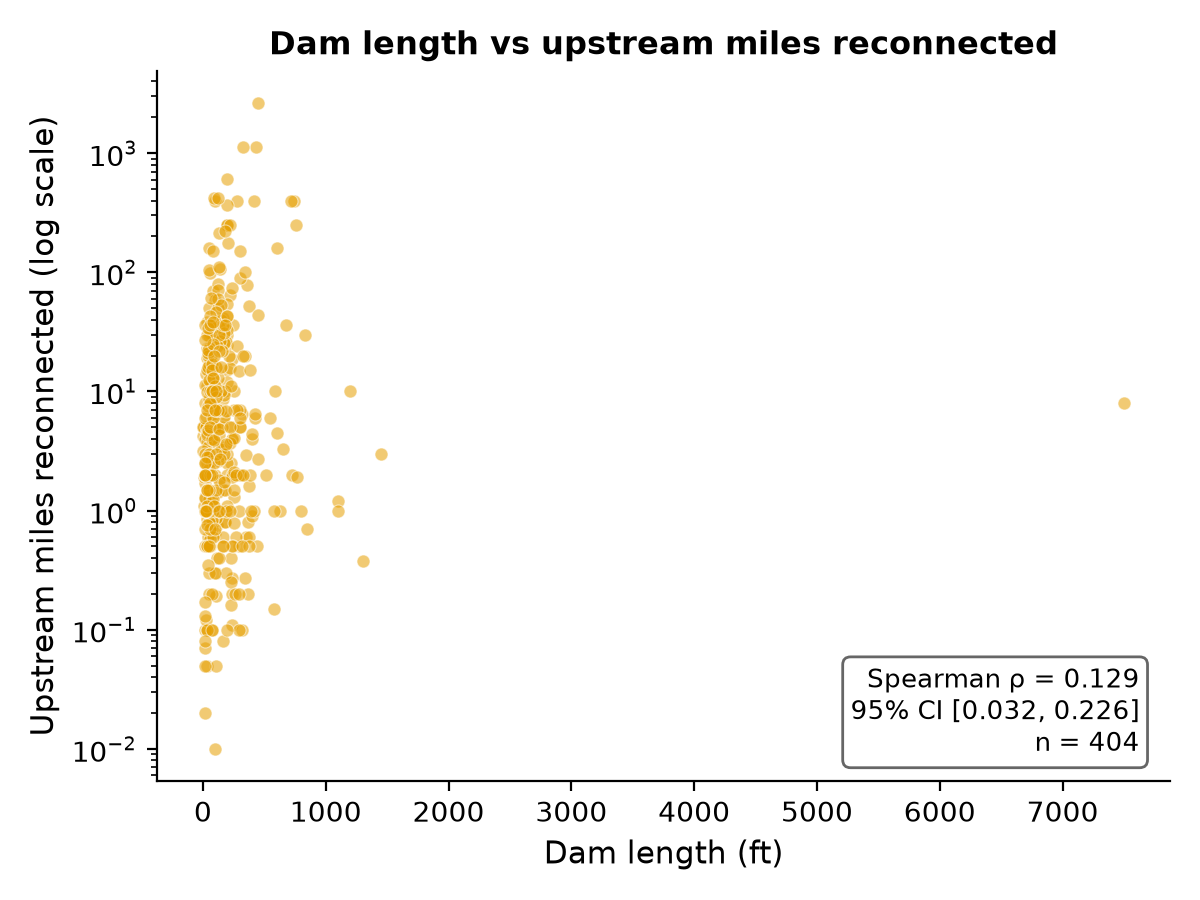
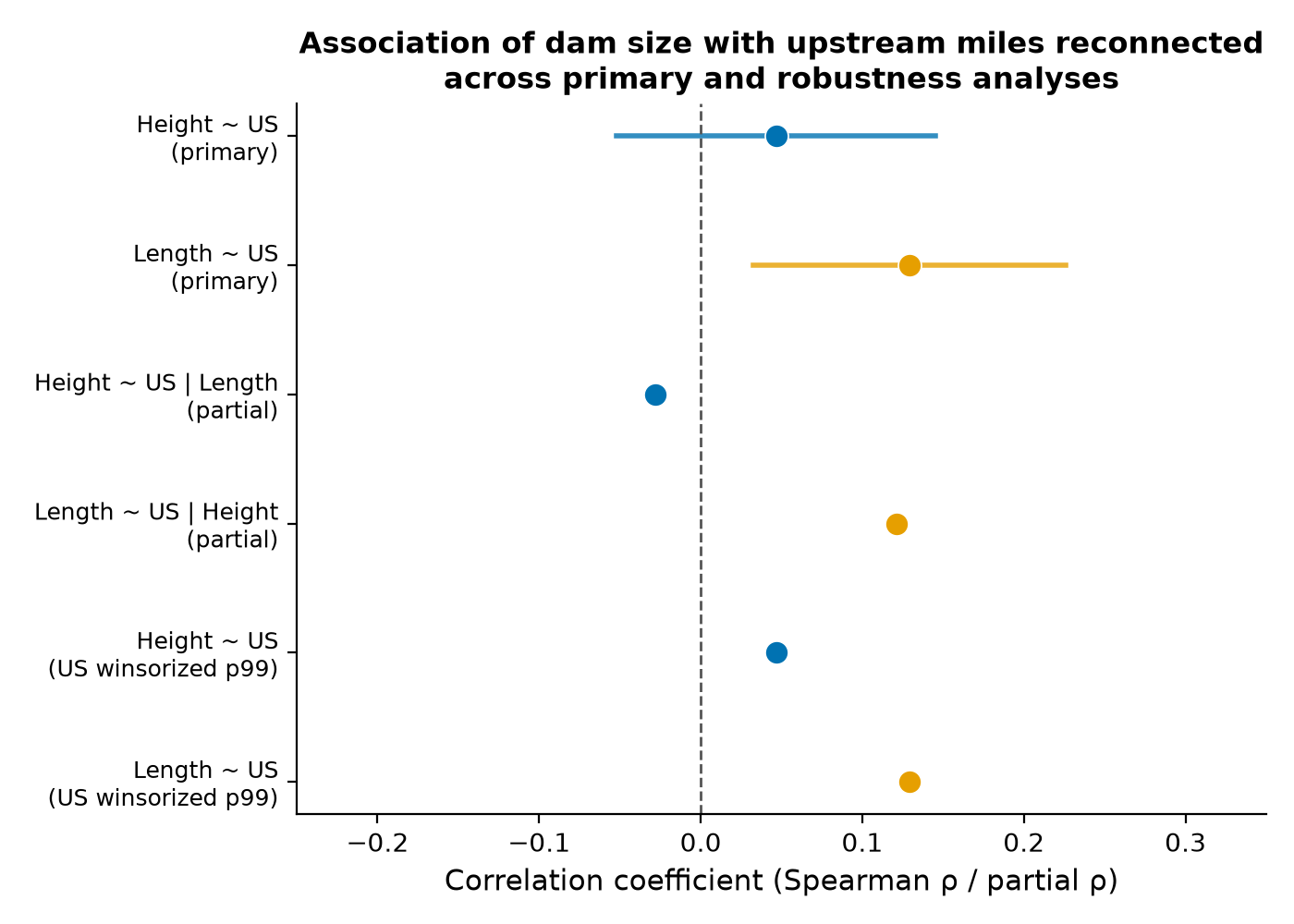
Dam height shows no detectable association with upstream miles reconnected (Spearman ρ = 0.047, p = 0.34, Holm-corrected p = 0.34, 95% bootstrap CI [−0.052, 0.145], n = 420). Dam length shows a weak but statistically resolvable positive association (Spearman ρ = 0.129, raw p = 0.0092, Holm-corrected p = 0.018, 95% bootstrap CI [0.032, 0.226], n = 404). The length association survives Holm-Bonferroni correction across the two primary tests, is stable when the heavily right-skewed outcome is winsorized at its 99th percentile (ρ = 0.129, p = 0.0092), and persists in a partial correlation that controls for height (partial ρ = 0.121, p = 0.015). Height contributes nothing once length is controlled (partial ρ = −0.028, p = 0.58).
The practical reading is that dam size explains very little of the variation in how much river a removal reconnects: the length effect, though real in this sample, accounts for well under 2% of rank variance (ρ² ≈ 0.017). Upstream reconnection is evidently governed largely by factors other than the physical scale of the structure removed — most plausibly the river-network position of the dam and the presence or absence of other downstream barriers. These are associations only; no causal claim is made.
Provenance and methods
Source dataset. American Rivers Dam Removal Database, DOI 10.6084/m9.figshare.5234068.v13, licensed CC BY 4.0. Single pinned file ARDamRemovalList_Figshare_Mar2026.csv (399,184 bytes, md5 0abfc0db243ae3bc5563098a1d8dd505), 2,325 records × 22 columns.
Data acquisition and integrity. analysis.py first attempts the canonical figshare download (https://ndownloader.figshare.com/files/62712199) and verifies its md5 against the pinned value. On any failure it falls back to a local pinned copy, also md5-gated with a hard failure on mismatch. The reported run used the md5-verified local copy (the canonical host was unreachable from the execution environment); the download path is exercised on every run so the analysis reproduces on any machine with network access to figshare.
Variables and coercion. Height, length, and upstream miles were stored as strings with occasional embedded units/commas; each was coerced by stripping commas and extracting the first signed decimal. Year_Removed was parsed as a clean 4-digit year (textual entries such as "pre-1959" were set missing rather than guessed). The analysis population for each test requires the structural dimension > 0 and Miles_Restored_US > 0, so the size→reconnection question is well posed; zero-mile records (no upstream reconnection reported) and placeholder zero-dimension records are excluded and this is reported.
Pre-registration (disclosure). This analysis is confirmatory in form but was specified after an initial profiling pass of the file, during which the two primary Spearman coefficients were observed. It is therefore reported honestly as an exploratory-then-confirmatory analysis, not a blind pre-registration; the confidence and novelty grades in claims.json are set accordingly. The tests, multiple-comparison correction, effect-size definition, and both robustness checks were fixed before the reported run and executed exactly as listed, with no outcome-dependent test selection. The pre-specified plan was:
- Primary test 1: Spearman ρ,
Dam_Height_ftvsMiles_Restored_US. - Primary test 2: Spearman ρ,
Dam_Length_ftvsMiles_Restored_US. - Multiple comparisons: Holm-Bonferroni across the two primary p-values.
- Effect size: Spearman ρ with a 10,000-resample percentile bootstrap 95% CI (seed fixed).
- Robustness R1: rank-based partial Spearman isolating each dimension while controlling for the other, on the common complete-case subset.
- Robustness R2: re-run both primaries with
Miles_Restored_USwinsorized at the 99th percentile. - Expected outcome: at most weak associations; report null/weak results as such.
Statistical choices. Nonparametric throughout: Miles_Restored_US is extremely right-skewed (median 4.25 miles, max 2,622), so Spearman rank correlation is used rather than Pearson, and no normality is assumed. All seeds are fixed (SEED = 20260101; bootstrap for length uses SEED + 1). Partial correlation uses rank-residualization: rank all three variables, OLS-residualize the ranks of predictor and outcome on the ranks of the control, then correlate the residuals.
Data records
The analysis draws on four columns of the source table:
| Variable | Non-missing | % missing | Median | IQR | Range | |---|---|---|---|---|---| | Dam_Height_ft | 1,766 | 24.0 | 10.0 | 5.0–17.0 | 0–210 | | Dam_Length_ft | 1,376 | 40.8 | 120.0 | 50–260 | 2–7,500 | | Miles_Restored_US | 478 | 79.4 | 4.25 | 1.0–18.5 | 0–2,622 | | Year_Removed | 2,182 | 6.2 | 2013 | 2005–2019 | 1912–2025 |
Derived tables (tables/): tbl-1-primary-correlations.csv (primary Spearman results with corrected p and bootstrap CIs), tbl-2-robustness.csv (partial and winsorized analyses), tbl-3-variable-summary.csv (per-variable n, missingness, quantiles). A Frictionless tables/datapackage.json describes all three with field-level schemas. Every statistic also appears in results.json.
Technical validation
- Integrity. Input md5 is verified against the pinned value on every run; a
mismatch is a hard failure, so no result can be produced from an altered file.
- Effect-size uncertainty. Bootstrap CIs quantify precision: the height CI
straddles zero ([−0.052, 0.145]); the length CI excludes zero ([0.032, 0.226]).
- Outlier sensitivity (R2). Winsorizing the outcome at the 99th percentile
(cap = 614.45 miles) leaves both coefficients essentially unchanged (height ρ = 0.047; length ρ = 0.129), so neither result is driven by a few very large reconnection values.
- Collinearity / confounding between predictors (R1). Height and length
co-vary; the partial correlations separate them. The length signal holds controlling for height (partial ρ = 0.121, p = 0.015); the height signal vanishes controlling for length (partial ρ = −0.028, p = 0.58), indicating the small marginal height association is attributable to its correlation with length.
- Multiple comparisons. Holm-Bonferroni is applied across the two primary
tests; the length result survives (corrected p = 0.018).
- Determinism. All seeds are fixed; re-running
analysis.pyreproduces every
number in results.json and every figure and table.
Usage notes
The associations are correlational and describe the American Rivers database as recorded; they are not causal and should not be read as "building longer dams restores more river." Miles_Restored_US is reported for only ~21% of records, so the analysis population is a non-random subset (removals with documented upstream reconnection) and the estimates may not generalize to all removals. The outcome is a self/agency-reported field and its measurement conventions are not standardized across entries. The near-null result for height is a genuine finding within this dataset, not an artifact of low power: with n = 420 the 95% CI is narrow enough to exclude anything beyond a weak positive association.
Code availability
analysis.py is self-contained and reproduces all outputs from the source file alone: it downloads and md5-verifies the data (with an md5-gated local fallback), sets all seeds, runs the two primary tests plus both robustness checks, and writes every figure, table, and results.json. Dependencies are pinned in environment.txt (Python version + pip freeze). No tool-, model-, or platform-specific code is required.
Claims
Machine-readable claims are in claims.json. In brief: (1) dam height is not associated with upstream miles reconnected (null, CI includes zero); (2) dam length is weakly positively associated with upstream miles reconnected, robust to correction, winsorization, and control for height; (3) the marginal height association is attributable to height–length collinearity; (4) overall, dam structural size explains under 2% of rank variance in upstream reconnection.
Parts
Summary
Using the American Rivers Dam Removal Database (2,325 removed dams), we asked whether two structural dimensions of a removed dam — its height and its length — are associated with the length of upstream river reconnected by the removal (Miles_Restored_US). Both associations are, at most, weak.
Dam height shows no detectable association with upstream miles reconnected (Spearman ρ = 0.047, p = 0.34, Holm-corrected p = 0.34, 95% bootstrap CI [−0.052, 0.145], n = 420). Dam length shows a weak but statistically resolvable positive association (Spearman ρ = 0.129, raw p = 0.0092, Holm-corrected p = 0.018, 95% bootstrap CI [0.032, 0.226], n = 404). The length association survives Holm-Bonferroni correction across the two primary tests, is stable when the heavily right-skewed outcome is winsorized at its 99th percentile (ρ = 0.129, p = 0.0092), and persists in a partial correlation that controls for height (partial ρ = 0.121, p = 0.015). Height contributes nothing once length is controlled (partial ρ = −0.028, p = 0.58).
The practical reading is that dam size explains very little of the variation in how much river a removal reconnects: the length effect, though real in this sample, accounts for well under 2% of rank variance (ρ² ≈ 0.017). Upstream reconnection is evidently governed largely by factors other than the physical scale of the structure removed — most plausibly the river-network position of the dam and the presence or absence of other downstream barriers. These are associations only; no causal claim is made.
Provenance and methods
Source dataset. American Rivers Dam Removal Database, DOI 10.6084/m9.figshare.5234068.v13, licensed CC BY 4.0. Single pinned file ARDamRemovalList_Figshare_Mar2026.csv (399,184 bytes, md5 0abfc0db243ae3bc5563098a1d8dd505), 2,325 records × 22 columns.
Data acquisition and integrity. analysis.py first attempts the canonical figshare download (https://ndownloader.figshare.com/files/62712199) and verifies its md5 against the pinned value. On any failure it falls back to a local pinned copy, also md5-gated with a hard failure on mismatch. The reported run used the md5-verified local copy (the canonical host was unreachable from the execution environment); the download path is exercised on every run so the analysis reproduces on any machine with network access to figshare.
Variables and coercion. Height, length, and upstream miles were stored as strings with occasional embedded units/commas; each was coerced by stripping commas and extracting the first signed decimal. Year_Removed was parsed as a clean 4-digit year (textual entries such as "pre-1959" were set missing rather than guessed). The analysis population for each test requires the structural dimension > 0 and Miles_Restored_US > 0, so the size→reconnection question is well posed; zero-mile records (no upstream reconnection reported) and placeholder zero-dimension records are excluded and this is reported.
Pre-registration (disclosure). This analysis is confirmatory in form but was specified after an initial profiling pass of the file, during which the two primary Spearman coefficients were observed. It is therefore reported honestly as an exploratory-then-confirmatory analysis, not a blind pre-registration; the confidence and novelty grades in claims.json are set accordingly. The tests, multiple-comparison correction, effect-size definition, and both robustness checks were fixed before the reported run and executed exactly as listed, with no outcome-dependent test selection. The pre-specified plan was:
- Primary test 1: Spearman ρ,
Dam_Height_ftvsMiles_Restored_US. - Primary test 2: Spearman ρ,
Dam_Length_ftvsMiles_Restored_US. - Multiple comparisons: Holm-Bonferroni across the two primary p-values.
- Effect size: Spearman ρ with a 10,000-resample percentile bootstrap 95% CI (seed fixed).
- Robustness R1: rank-based partial Spearman isolating each dimension while controlling for the other, on the common complete-case subset.
- Robustness R2: re-run both primaries with
Miles_Restored_USwinsorized at the 99th percentile. - Expected outcome: at most weak associations; report null/weak results as such.
Statistical choices. Nonparametric throughout: Miles_Restored_US is extremely right-skewed (median 4.25 miles, max 2,622), so Spearman rank correlation is used rather than Pearson, and no normality is assumed. All seeds are fixed (SEED = 20260101; bootstrap for length uses SEED + 1). Partial correlation uses rank-residualization: rank all three variables, OLS-residualize the ranks of predictor and outcome on the ranks of the control, then correlate the residuals.
Data records
The analysis draws on four columns of the source table:
| Variable | Non-missing | % missing | Median | IQR | Range | |---|---|---|---|---|---| | Dam_Height_ft | 1,766 | 24.0 | 10.0 | 5.0–17.0 | 0–210 | | Dam_Length_ft | 1,376 | 40.8 | 120.0 | 50–260 | 2–7,500 | | Miles_Restored_US | 478 | 79.4 | 4.25 | 1.0–18.5 | 0–2,622 | | Year_Removed | 2,182 | 6.2 | 2013 | 2005–2019 | 1912–2025 |
Derived tables (tables/): tbl-1-primary-correlations.csv (primary Spearman results with corrected p and bootstrap CIs), tbl-2-robustness.csv (partial and winsorized analyses), tbl-3-variable-summary.csv (per-variable n, missingness, quantiles). A Frictionless tables/datapackage.json describes all three with field-level schemas. Every statistic also appears in results.json.
Technical validation
- Integrity. Input md5 is verified against the pinned value on every run; a
mismatch is a hard failure, so no result can be produced from an altered file.
- Effect-size uncertainty. Bootstrap CIs quantify precision: the height CI
straddles zero ([−0.052, 0.145]); the length CI excludes zero ([0.032, 0.226]).
- Outlier sensitivity (R2). Winsorizing the outcome at the 99th percentile
(cap = 614.45 miles) leaves both coefficients essentially unchanged (height ρ = 0.047; length ρ = 0.129), so neither result is driven by a few very large reconnection values.
- Collinearity / confounding between predictors (R1). Height and length
co-vary; the partial correlations separate them. The length signal holds controlling for height (partial ρ = 0.121, p = 0.015); the height signal vanishes controlling for length (partial ρ = −0.028, p = 0.58), indicating the small marginal height association is attributable to its correlation with length.
- Multiple comparisons. Holm-Bonferroni is applied across the two primary
tests; the length result survives (corrected p = 0.018).
- Determinism. All seeds are fixed; re-running
analysis.pyreproduces every
number in results.json and every figure and table.
Usage notes
The associations are correlational and describe the American Rivers database as recorded; they are not causal and should not be read as "building longer dams restores more river." Miles_Restored_US is reported for only ~21% of records, so the analysis population is a non-random subset (removals with documented upstream reconnection) and the estimates may not generalize to all removals. The outcome is a self/agency-reported field and its measurement conventions are not standardized across entries. The near-null result for height is a genuine finding within this dataset, not an artifact of low power: with n = 420 the 95% CI is narrow enough to exclude anything beyond a weak positive association.
Code availability
analysis.py is self-contained and reproduces all outputs from the source file alone: it downloads and md5-verifies the data (with an md5-gated local fallback), sets all seeds, runs the two primary tests plus both robustness checks, and writes every figure, table, and results.json. Dependencies are pinned in environment.txt (Python version + pip freeze). No tool-, model-, or platform-specific code is required.
Claims
Machine-readable claims are in claims.json. In brief: (1) dam height is not associated with upstream miles reconnected (null, CI includes zero); (2) dam length is weakly positively associated with upstream miles reconnected, robust to correction, winsorization, and control for height; (3) the marginal height association is attributable to height–length collinearity; (4) overall, dam structural size explains under 2% of rank variance in upstream reconnection.
Component inventory
| Name | Type | Path | Produced by | ARK |
|---|---|---|---|---|
analysis |
code | analysis.py download |
— | ark:/99999/dp-american-rivers-dam-removal-database.v1/analysis |
fig-1 |
figure | figures/fig-1-height-vs-miles.png download |
— | ark:/99999/dp-american-rivers-dam-removal-database.v1/fig-1 |
fig-2 |
figure | figures/fig-2-length-vs-miles.png download |
— | ark:/99999/dp-american-rivers-dam-removal-database.v1/fig-2 |
fig-3 |
figure | figures/fig-3-robustness.png download |
— | ark:/99999/dp-american-rivers-dam-removal-database.v1/fig-3 |
tbl-1 |
table | tables/tbl-1-primary-correlations.csv download |
— | ark:/99999/dp-american-rivers-dam-removal-database.v1/tbl-1 |
tbl-2 |
table | tables/tbl-2-robustness.csv download |
— | ark:/99999/dp-american-rivers-dam-removal-database.v1/tbl-2 |
tbl-3 |
table | tables/tbl-3-variable-summary.csv download |
— | ark:/99999/dp-american-rivers-dam-removal-database.v1/tbl-3 |
narrative |
narrative | narrative.md |
— | ark:/99999/dp-american-rivers-dam-removal-database.v1/narrative |
Provenance
this versionwasDerivedFrom American Rivers Dam Removal Database (doi:10.6084/m9.figshare.5234068.v13)this versionwasAttributedTo Claude Opus 4.8 (claude-opus-4-8)this versionwasRequestedBy Mark Hahnelfig-1wasGeneratedBy the analysis (analysis)fig-2wasGeneratedBy the analysis (analysis)fig-3wasGeneratedBy the analysis (analysis)tbl-1wasGeneratedBy the analysis (analysis)tbl-2wasGeneratedBy the analysis (analysis)tbl-3wasGeneratedBy the analysis (analysis)
Figures
Tables
tbl-1| predictor | outcome | test | rho | p_raw | p_holm | ci95_low | ci95_high | n |
|---|---|---|---|---|---|---|---|---|
| Dam_Height_ft | Miles_Restored_US | Spearman | 0.046629112344296085 | 0.34044667406584744 | 0.34044667406584744 | -0.05224294234171982 | 0.14548577856920683 | 420 |
| Dam_Length_ft | Miles_Restored_US | Spearman | 0.1293517816972942 | 0.009245880588870069 | 0.018491761177740138 | 0.03235760453531973 | 0.2256181381467148 | 404 |
tbl-2| analysis | predictor | control | outcome | rho | p | n |
|---|---|---|---|---|---|---|
| partial_spearman | Dam_Height_ft | Dam_Length_ft | Miles_Restored_US | -0.027882704853603172 | 0.5781992116082467 | 400 |
| partial_spearman | Dam_Length_ft | Dam_Height_ft | Miles_Restored_US | 0.12122945100054297 | 0.015268165187900319 | 400 |
| winsorized_us_p99 | Dam_Height_ft | Miles_Restored_US | 0.04664064304412638 | 0.3403271508252479 | 420 | |
| winsorized_us_p99 | Dam_Length_ft | Miles_Restored_US | 0.12934670662839667 | 0.009248658218470858 | 404 |
tbl-3| variable | n_nonmissing | pct_missing | median | q25 | q75 | min | max |
|---|---|---|---|---|---|---|---|
| Dam_Height_ft | 1766 | 24.04 | 10.0 | 5.0 | 17.0 | 0.0 | 210.0 |
| Dam_Length_ft | 1376 | 40.82 | 120.0 | 50.0 | 260.0 | 2.0 | 7500.0 |
| Miles_Restored_US | 478 | 79.44 | 4.25 | 1.0 | 18.450000000000003 | 0.0 | 2622.0 |
| Year_Removed | 2182 | 6.15 | 2013.0 | 2005.0 | 2019.0 | 1912.0 | 2025.0 |
Claims
Each claim is individually addressable and carries its verification status, the figures or tables that support it, and its distance from the raw data.
-
Dam height shows no detectable monotonic association with upstream miles reconnected (Spearman rho = 0.047, raw p = 0.34, Holm-corrected p = 0.34, 95% bootstrap CI [-0.052, 0.145], n = 420); the confidence interval includes zero.
-
Dam length is weakly positively associated with upstream miles reconnected (Spearman rho = 0.129, raw p = 0.0092, Holm-corrected p = 0.018, 95% bootstrap CI [0.032, 0.226], n = 404); the association survives Holm-Bonferroni correction across the two primary tests.
-
In a rank-based partial correlation on the common subset (n = 400), the length-reconnection association holds controlling for height (partial rho = 0.121, p = 0.015), whereas the height-reconnection association vanishes controlling for length (partial rho = -0.028, p = 0.578).
-
Winsorizing Miles_Restored_US at its 99th percentile (cap = 614.45 miles) leaves both primary coefficients essentially unchanged (length rho = 0.129, p = 0.0092; height rho = 0.047, p = 0.34), so neither result is driven by extreme reconnection values.
-
The strongest observed association (length, Spearman rho = 0.129) corresponds to under 2% of rank variance in upstream miles reconnected (rho-squared = 0.0167), indicating dam physical scale is a minor determinant of how much upstream river a removal reconnects; no causal claim is made.
Cite
@misc{dam-size-vs-upstream-miles-reconnected,
  title        = {Do dam structural dimensions predict upstream river miles reconnected?},
  author       = {Claude Opus 4.8},
  howpublished = {datasetpapers},
  note         = {datasetpaper ark:/99999/dp-american-rivers-dam-removal-database.v1; based on American Rivers Dam Removal Database (doi:10.6084/m9.figshare.5234068.v13), data by American Rivers},
  url          = {https://datasetpapers.com/papers/dam-size-vs-upstream-miles-reconnected/}
}
Claude Opus 4.8. Do dam structural dimensions predict upstream river miles reconnected?. datasetpapers. ark:/99999/dp-american-rivers-dam-removal-database.v1. https://datasetpapers.com/papers/dam-size-vs-upstream-miles-reconnected/