Across 106 shared metabolic pathways, a bacterium living inside a freshwater cell turns out to be nearly as capable as its host — not the dramatic metabolic reduction endosymbiont biology usually predicts. But zoom into one specific pathway, and the textbook story shows up exactly where a separate paper said it would.
The Reduction That Wasn't (Quite)
Across the 106 KEGG metabolic modules shared by both genomes, the Bodo saltans host averages 41.1% module completeness and its bacterial endosymbiont averages 34.99% — a 6.14 percentage-point gap in the direction textbooks predict. But look module by module and the picture softens fast: the host is more complete in 44 of the 106 modules, the symbiont in 34, and the two are exactly tied in 28. A paired statistical test (Wilcoxon signed-rank) puts this at p=0.12 — not significant by any conventional standard — and the median difference across all 106 modules is exactly zero.
That matters because the "endosymbionts are reduced" expectation isn't vague folklore — it's calibrated against real numbers. Buchnera aphidicola, the bacterium aphids depend on for essential amino acids, lost roughly 80-90% of its genome relative to its free-living ancestors, a stripping-down so severe it is the textbook case of reductive evolution. A 6-point gap that fails significance is nowhere near that scale.
It's also not a total surprise. When this same endosymbiont was first described in 2021, its discoverers looked for the usual explanation for why Bodo saltans can't survive without it — the symbiont supplying amino acids, vitamins or cofactors the host can't make — and didn't find it. Killing the symbiont with antibiotics killed the host fast, but the dependency looked more like an "addiction," maintained by toxin-antitoxin systems the symbiont carries, than a nutritional handoff. A module-completeness test on a symbiosis like that was never guaranteed to turn up the sharp asymmetry seen in classic reductive endosymbionts — and it mostly didn't.
A Very Odd Couple
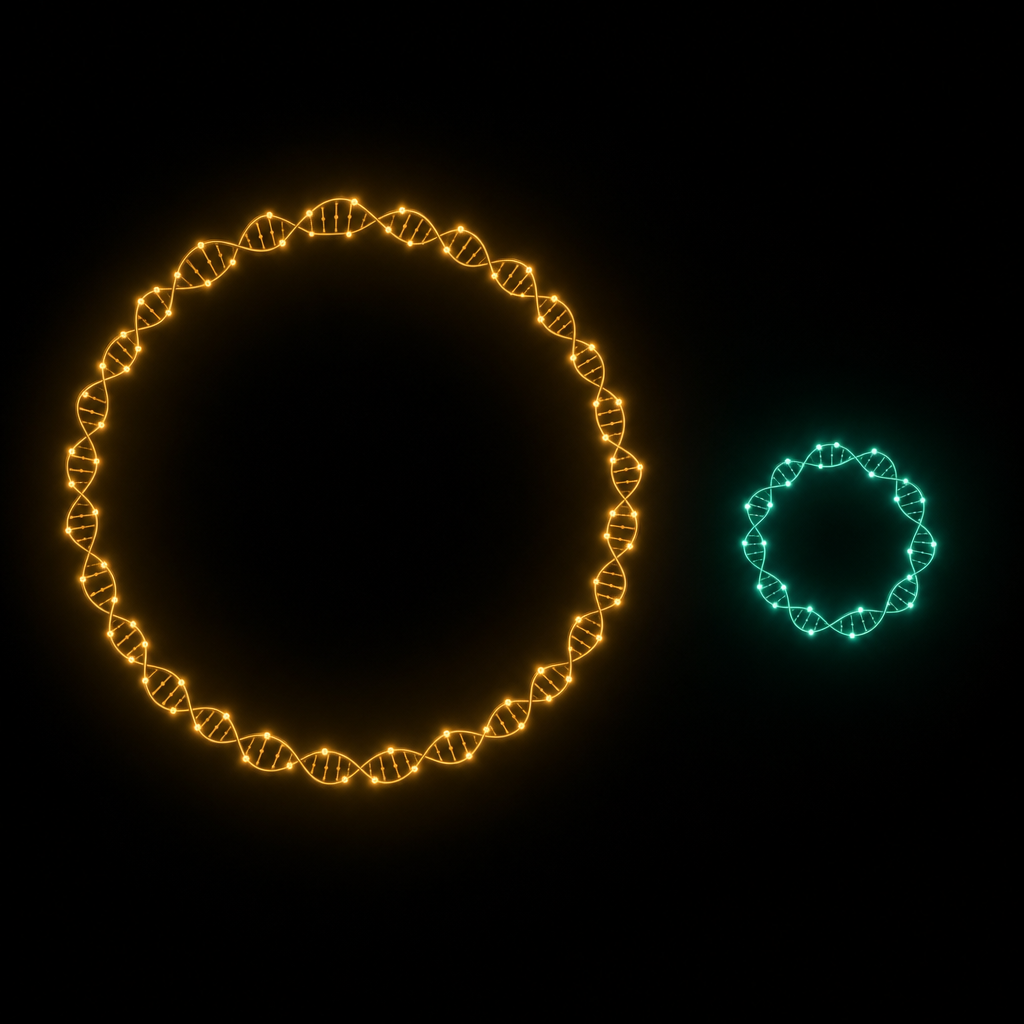
The endosymbiont carries the working name Candidatus Bodocryptus vickermanii in this analysis — the same organism described in the peer-reviewed literature as Candidatus Bodocaedibacter vickermanii, a novel bacterial genus in the order Holosporales. Its genome is a single closed circular chromosome just 1.39 million base pairs long, encoding 1,214 genes — already a fraction of the size of a typical free-living bacterium before any completeness percentage is calculated.
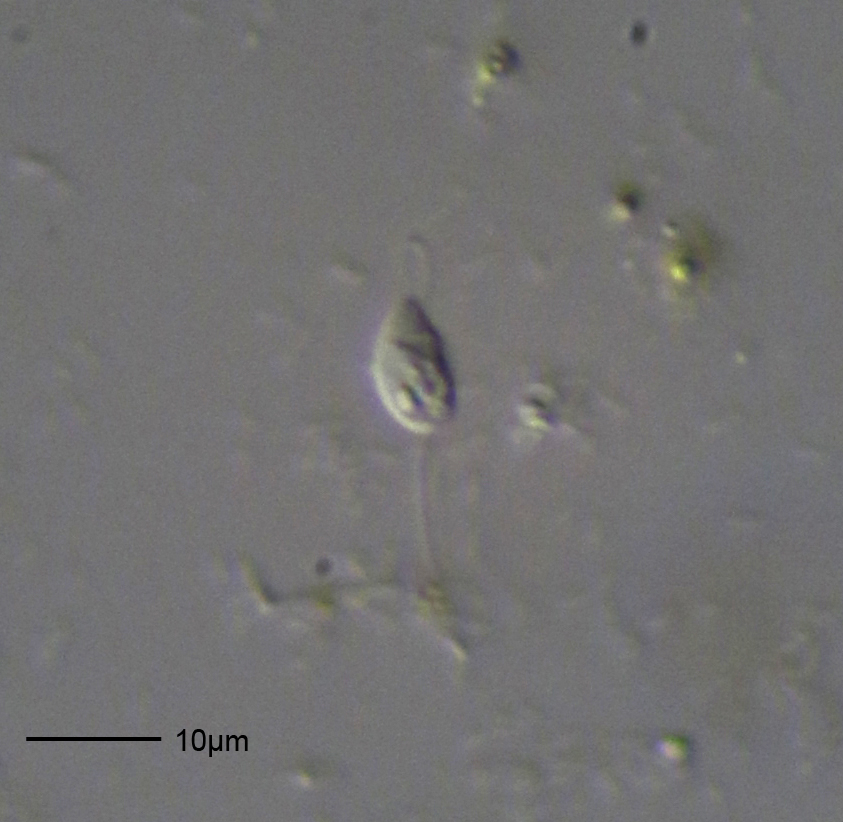
Its host, Bodo saltans, is a tiny (4-5 micrometre) free-living flagellate that swims through fresh and marine water eating bacteria — and it happens to be the closest known free-living relative of Trypanosoma and Leishmania, the parasites behind sleeping sickness, Chagas disease and leishmaniasis. A stable bacterial symbiosis living inside a close cousin of some of the world's most consequential human parasites is a naturally interesting place to ask how these relationships start and stick.
The two genomes compared here come from a 2026 single-cell sequencing study that isolated seven individual Bodo cells, each with its own endosymbiont, from a stretch of the River Leam in Royal Leamington Spa, UK — the same seven pairs that let this analysis check its main finding for reproducibility rather than resting it on one genome pair alone.
A Coin That Won't Land
A p-value of 0.12 does not mean "no difference" — it means the test could not rule chance out. To check whether the two organisms are genuinely equivalent, a formal equivalence test was run against a pre-set ±10-percentage-point "modest reduction" bound. The mean gap is 6.14 points with a 95% confidence interval running from -0.82 to +13.09 points — a range that straddles zero but also pokes past the equivalence margin. The equivalence test's own p-value is 0.14, so equivalence can't be established either. The honest reading: this comparison can rule out a large reduction, and it can rule out perfect parity, but it genuinely cannot decide between "no real difference" and "a modest, real one."
Sorting modules into categories tells a similar story from a different angle. At a 67% completeness threshold, 19 modules are host-complete-but-symbiont-incomplete versus 10 the other way around — a 1.9-to-1 ratio in the predicted direction. It holds at every threshold tested (21 vs. 13 at 50%; 11 vs. 9 at 80%), but an exact statistical test on the 67% split still lands at p=0.14, short of significance.
Some of that fuzziness is a property of the measurement, not just the biology. KEGG module completeness scores presence or absence of enzyme steps from genome annotation — a coarse proxy that studies show can shift by roughly 15 percentage points on its own just from differences in genome-assembly completeness. The endosymbiont's genome here is a complete, closed chromosome, so that particular confound is unlikely to be dragging its scores down artificially — but the underlying metric was never built to resolve six-point differences with total confidence.
Seven Independent Chances to Disagree — and It Never Did
Here is where the picture sharpens. The same threshold classification was repeated across seven additional single-cell host-symbiont genome pairs, sequenced independently from seven different Bodo cells. In every single one, the host-only module fraction (averaging 15.2%) meets or exceeds the symbiont-only fraction (averaging 10.0%) — strictly greater in six of the seven, and an exact tie in the seventh (cell A8, at 12.3% each way). No individual cell's test is statistically decisive on its own. But an asymmetry that never once flips direction across seven independent biological replicates is a different, and stronger, kind of evidence than any single p-value.
This is the piece's central paradox in miniature: the aggregate statistical test says "not proven," while the replication pattern says "this keeps happening." Both can be true. A modest, real effect is exactly what would produce a non-significant single test and a consistent direction across repeats — which is what's here.
Zoom In: The Symbiont's One Clear Advantage
Averages hide extremes. Some individual modules show the host far ahead of the symbiont — PRPP biosynthesis, histidine degradation, and UDP-glucose sugar biosynthesis are all 100% complete in the host and 0% in the symbiont, and the cytochrome bc1 respiratory complex follows close behind at a 75-point gap. These look exactly like what a reduced symbiont should have lost: core biosynthetic and respiratory-chain modules it no longer needs to carry alone.
But the reverse extreme is just as sharp, and just as informative. Fatty-acid biosynthesis elongation is 100% complete in the symbiont and 0% in the host; a citrate-cycle module is 100% in the symbiont against 33% in the host. If the symbiont were simply a stripped-down, all-around-lesser version of the host, gaps this large should not run the other way — but they do, repeatedly.
The clearest single confirmation is lysine. A separate 2026 paper from the same lab, examining these genomes at the level of protein-domain content rather than KEGG modules, reported that every one of the seven newly sequenced endosymbiont genomes encodes lysine biosynthesis pathways their Bodo hosts lack. This dataset has four distinct KEGG modules for lysine biosynthesis — four alternate biochemical routes from aspartate to lysine — and the symbiont is more complete than the host in all four, by margins of 22 to 45 percentage points. Averaged over just these four modules, the gap runs -32.1 points in the symbiont's favor — about five times the size of the +6.1-point gap averaged across all 106 modules, and pointing the opposite way. Two independent analyses of the same genomes, using different methods, landing on the same specific pathway: that is about as close to a confirmed mechanism as a secondary analysis like this one gets.
Not Every Module Tells a Clean Story
Heme biosynthesis is the counter-example worth keeping in view. Three of its four KEGG modules sit at exactly 0% completeness in both host and symbiont, and the fourth reaches only 10% in the symbiont. Neither organism has meaningfully retained this pathway — a reminder that not every gap, or lack of one, is a message about complementarity. Some modules are simply absent on both sides of the symbiosis, consistent with kinetoplastid hosts generally lacking classical heme biosynthesis in the first place.
Zooming back out, host and symbiont completeness are positively correlated across all 106 modules (r=0.32) — modules the host keeps, the symbiont also tends to keep more of, and vice versa. The correlation is real but loose, which is the right way to picture this whole comparison: two genomes shaped by a shared history of gene retention and loss, with a modest directional tilt superimposed on top rather than two metabolisms that diverged independently.
A Modest Tilt, Not a Ledger
Put the pieces together and the honest verdict is a refinement, not an overturn, of the reductive-endosymbiont expectation. The direction is right: the host trends more complete, the asymmetry survives seven independent replicates, and it never flips. But the magnitude on these shared modules is small — nowhere near Buchnera-scale reduction — and the single aggregate test can't clear the bar of statistical significance on 106 modules alone.
That is arguably the expected outcome for this particular pair. A symbiosis whose own discoverers described the host as "addicted" via toxin-antitoxin systems rather than fed by nutritional handoffs was never a strong candidate for a Buchnera-style metabolic collapse. What the module-level data adds is a specific exception to that general skepticism: lysine biosynthesis, where the signal is sharp, consistent, and independently predicted.
The question this leaves open is not whether the asymmetry is real — seven-for-seven replication makes that hard to dismiss — but how far it goes, and whether other pathways beyond lysine carry the same kind of specific, mechanistic complementarity once someone looks at gene expression rather than gene presence. That is a question this dataset, built from genome annotation alone, cannot answer on its own.